How Moonlight Affects Stargazing

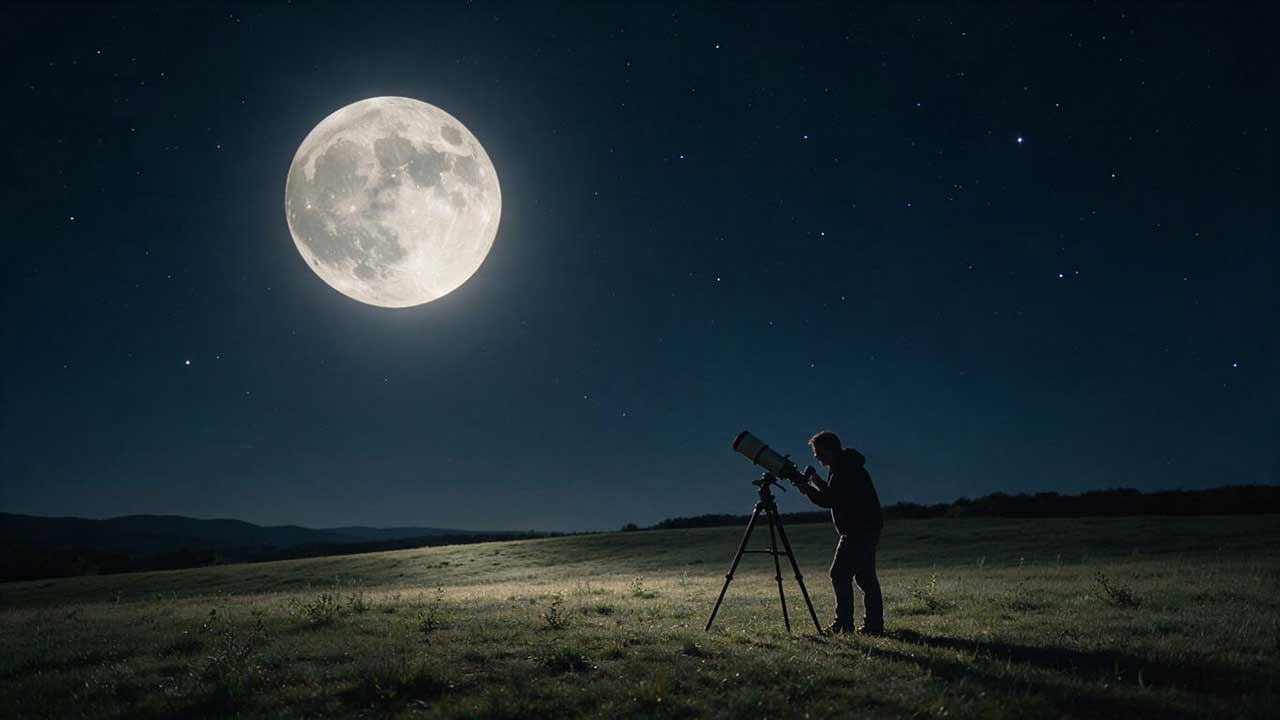
Moonlight brightens the sky by scattering reflected sunlight through Earth’s atmosphere, reducing the contrast between faint celestial objects and the background. The effect is strongest when the Moon is bright, high above the horizon, and near the target. Plan faint-object sessions near new Moon or after moonset, and use brighter Moon phases for planets, double stars, star clusters, and lunar observing.
Key Takeaways
- Moonlight does not erase stars equally; it mainly reduces the contrast of faint, diffuse objects such as galaxies, nebulae, the Milky Way, and zodiacal light.
- Moon phase alone is not enough for planning. Moonrise, moonset, altitude, angular separation, haze, and local light pollution also matter.
- A first-quarter or last-quarter Moon can still leave part of the night moon-free.
- Bright Moon nights remain useful for the Moon itself, planets, double stars, many bright clusters, and equipment practice.
- Dark adaptation still matters on moonlit nights, but an exposed bright Moon can reduce sensitivity to faint detail.
This guide explains which targets moonlight affects most, how to plan around the Moon’s position rather than phase alone, and how to rescue an observing session when the sky is brighter than expected.
Why Does Moonlight Make Faint Objects Harder to See?
Moonlight raises the brightness of the sky background, which lowers contrast. The Moon does not produce its own light; moonlight is sunlight reflected from the lunar surface.[1] When that light enters Earth’s atmosphere, molecules, aerosols, haze, and thin cloud scatter part of it across the sky.
A telescope can collect more light from a target, but it also collects more light from the brightened background. This is why a larger aperture does not fully restore the view of a low-contrast galaxy under a bright Moon.
The effect is easiest to understand as a contrast problem:
- A bright planet remains much brighter than the surrounding sky.
- A faint galaxy may be only slightly brighter than the surrounding sky.
- When moonlight brightens that background, the galaxy becomes harder to distinguish even though the galaxy itself has not changed.
Professional observatories also treat lunar illumination, Moon altitude, target–Moon separation, and wavelength as observing constraints because scattered moonlight changes optical sky brightness.[2][3]
Which Factors Determine How Much Moonlight Matters?
Moon phase is important, but it is only one part of the decision.
| Factor | Why it matters | Practical implication |
|---|---|---|
| Illuminated fraction | A more illuminated lunar disk generally sends more reflected sunlight toward Earth | Gibbous and full phases usually brighten the sky more |
| Moon altitude | A high Moon can illuminate a larger, clearer path through the sky | Faint-object contrast is often worse when the Moon is high |
| Moon–target separation | Targets closer to the Moon usually suffer more scattered light and glare | Observe faint targets far from the Moon |
| Atmospheric transparency | Haze, smoke, humidity, dust, and thin cloud scatter light | A hazy quarter Moon may be more disruptive than expected |
| Local light pollution | Artificial skyglow adds to the natural moonlit background | Moonlight has a larger practical cost at already bright locations |
| Target type | Diffuse targets depend more on background contrast than bright point-like targets | Switch target lists instead of cancelling automatically |
| Magnification and exit pupil | Image scale and background brightness change through the eyepiece | Moderate magnification may improve some observations |
| Direct glare | Seeing the bright Moon or nearby lights reduces visual comfort and dark adaptation | Block direct light with terrain, a hood, or careful positioning |
Gemini Observatory’s sky-background guidance identifies lunar phase as a primary influence and target–Moon distance as another important variable, alongside zenith angle and other conditions.[3] This is why an illumination percentage without a rise/set time or sky position can be misleading.
How Do Moon Phases Change the Best Observing Time?
The Moon’s phase helps predict when it will be above the horizon. NASA explains that the lunar phase cycle repeats about every 29.5 days and gives the approximate rise and set pattern for the major phases.[4]
| Moon phase | Approximate timing | Best practical use |
|---|---|---|
| New Moon | Rises and sets with the Sun | Faint galaxies, nebulae, Milky Way, meteor observing |
| Waxing crescent | Visible after sunset, sets later each evening | Observe faint targets after moonset |
| First quarter | Rises around midday, sets around the middle of the night | Bright targets early; faint targets after moonset |
| Waxing gibbous | Up through much of the evening and early night | Moon, planets, double stars, bright clusters |
| Full Moon | Rises near sunset and sets near sunrise | Lunar observing and bright targets |
| Waning gibbous | Rises later in the evening | Faint-object observing before moonrise |
| Last quarter | Rises around the middle of the night and sets around midday | Faint targets in the evening; Moon later |
| Waning crescent | Rises before dawn | Long dark evening for deep-sky observing |
These are approximate patterns, not exact local times. Use a location-specific source such as the U.S. Naval Observatory’s Sun and Moon data service, which provides rise, set, transit, twilight, phase, and illumination information for a selected date and location.[5]
Why Is Moonset Often More Useful Than the Phase Label?
A 50% illuminated Moon may sound like a poor observing night, but a first-quarter Moon can set around the middle of the night. The hours after moonset may be excellent if the sky is transparent and the target is still well placed.
Likewise, a waning gibbous Moon may leave a dark evening before it rises. Planning by clock time can recover several useful observing hours that a phase-only calendar would make easy to overlook.
Which Objects Are Most Affected by Moonlight?
The more an object depends on low surface brightness and subtle contrast, the more moonlight usually matters.
Most Affected
- Milky Way structure
- Faint galaxies
- Large diffuse nebulae
- Reflection nebulae
- Low-surface-brightness planetary nebulae
- Zodiacal light
- Gegenschein
- Faint comet tails
- Weak meteor activity
- Dark nebulae
- Very faint outer halos of brighter objects
Moderately Affected
- Many globular clusters
- Smaller planetary nebulae
- Bright emission nebulae
- Fainter open clusters
- Faint asteroids
- Comets with concentrated comae
- Double stars with a faint companion
Least Affected
- The Moon
- Venus, Jupiter, Saturn, and Mars when well placed
- Bright double stars
- Bright open clusters
- Many carbon stars and colored stars
- Major lunar occultations
- Artificial satellites
- Equipment alignment and focusing practice
The Royal Astronomical Society of Canada notes that moonlight interferes with observing and photographing faint deep-sky objects, while the Moon itself remains detailed and accessible even from urban locations.[6]
Does a Full Moon Ruin Stargazing?
No. A full Moon is poor for many faint deep-sky targets, but it can support an excellent observing session if the target list matches the conditions.
A full Moon is useful for:
- Learning lunar geography
- Comparing maria, rays, and large craters
- Observing planets
- Splitting suitable double stars
- Viewing bright open clusters
- Testing telescope alignment
- Practicing star hopping with bright guide stars
- Checking finder scope alignment
- Conducting outreach for beginners
- Walking or navigating a dark location with less artificial light
The National Park Service distinguishes between moonless nights for seeing more stars and bright full-Moon nights for illuminated landscapes and night walks.[7][8]
Is Full Moon the Best Time to Observe Lunar Detail?
Not always. Near full Moon, sunlight reaches much of the visible lunar surface from a nearly frontal angle, so shadows are shorter and some relief looks flatter.
Features close to the lunar terminator—the boundary between lunar day and night—often show stronger shadows and more obvious topography. First-quarter and last-quarter periods can therefore be especially rewarding for crater rims, mountains, valleys, and ridges.[6]
How Far From the Moon Should You Observe?
There is no single angular separation that guarantees a dark background. Larger separation generally helps, but the outcome also depends on Moon altitude, illumination, atmospheric scattering, target wavelength, and local conditions.
European Southern Observatory guidance notes that optical moonlight effects depend on lunar illumination and Moon–target distance, and that useful minimum-distance choices vary by wavelength and observing conditions.[2] That professional guidance should not be converted into one rigid amateur rule.
Use this field framework instead:
| Moon position relative to target | Likely effect | Recommended response |
|---|---|---|
| Moon in the same field or very nearby | Strong glare and reduced contrast | Change targets or wait |
| Moon in the same general region of sky | Noticeable brightening, especially with haze | Choose bright or compact targets |
| Moon far across the sky | Less direct contamination, but background may remain bright | Test the target and compare nearby sky |
| Moon low near horizon | Sometimes less disruptive, but haze can scatter strongly | Judge transparency, not altitude alone |
| Moon below horizon | Direct moonlight greatly reduced | Best window for faint targets |
A tree, building, ridge, or observatory wall can block direct glare without changing the atmospheric sky brightness. This can still improve comfort and preserve visual sensitivity.
How Does Atmospheric Haze Change the Effect?
Haze often makes moonlight more disruptive because suspended particles scatter light. Thin cloud can be especially deceptive: stars may remain visible while the entire sky develops a bright veil.
Watch for:
- A large glow around the Moon
- Milky-looking sky near the horizon
- Reduced contrast around bright stars
- Fewer visible stars at the same location
- A bright background through the telescope
- Rapid changes as thin cloud passes
A transparent night with a modest Moon can outperform a hazy night with a thinner crescent. Treat transparency and Moon conditions as separate planning variables.
Can Humidity Alone Predict the Result?
No. Relative humidity is not a direct measurement of astronomical transparency. Local aerosols, smoke, dust, cloud, altitude, temperature structure, and moisture all influence scattering.
Use the visible halo around the Moon, clarity near the horizon, star counts, and local astronomy forecasts as practical checks.
How Does Moonlight Affect Dark Adaptation?
Moonlight can reduce the eye’s sensitivity to faint detail, especially when the bright lunar disk enters direct view. The National Park Service explains that rod-based night vision develops gradually and that bright light can disrupt the chemical process supporting dark adaptation.[9]
A commonly used practical range is to allow roughly 20–40 minutes for substantial dark adaptation, although the exact experience varies among individuals and conditions.[9]
How Can You Protect Dark Adaptation Near the Moon?
- Keep the Moon outside the direct field of view when searching for faint objects.
- Use terrain, a building, or an observing hood to block glare.
- Use the dimmest practical red light.
- Lower phone brightness and use a red-screen mode.
- Avoid viewing white menus or headlights.
- Observe the Moon near the end of a mixed target session.
- Close or cover the non-observing eye when looking at a bright display.
- Give your eyes time to recover before returning to faint objects.
A red light should still be dim. A bright red lamp can interfere with night vision and distract other observers.[9]
Can Magnification Reduce the Impact of Moonlight?
Sometimes. Increasing magnification makes the sky background appear darker through the eyepiece because the exit pupil becomes smaller. This can improve the perceived contrast of certain compact objects.
However, magnification also spreads an extended object’s light over a larger apparent area and may make the image too dim. The best magnification depends on the object, telescope aperture, sky brightness, seeing, and observer.
A Practical Magnification Test
- Center the target at low power.
- Increase magnification one step.
- Compare the target’s structure against the sky background.
- Increase again only if detail becomes easier to detect.
- Stop when the image grows dimmer without revealing more information.
This method is more reliable than assuming that either the lowest or highest magnification is always best.
Do Nebula Filters Remove Moonlight?
No visual filter turns a moonlit sky into a moonless sky.
Narrowband and line filters can improve the contrast of certain emission nebulae by transmitting selected wavelengths while reducing other light. They do not help all targets, and they are generally not useful for restoring the broadband light of galaxies, reflection nebulae, or star clusters.
Use filters as target-specific tools, not as substitutes for timing and transparency.
When Might a Filter Be Worth Trying?
- Bright emission nebulae
- Some planetary nebulae
- Targets far from the Moon
- Moderate rather than severe sky brightening
- Telescopes with enough light-gathering capacity for the chosen exit pupil
Compare the filtered and unfiltered view. If the target becomes too dim or loses useful star context, remove the filter.
How Does Moonlight Affect Binoculars and Telescopes Differently?
Moonlight affects contrast in both instruments, but the observing experience differs.
Binoculars
Binoculars are excellent for:
- Bright open clusters
- Lunar viewing
- Large star patterns
- Bright comets
- Scanning the Moon’s surroundings
- Wide-field navigation practice
Large exit pupils can show a bright background under moonlight. A smaller binocular exit pupil may produce a darker-looking sky, but aperture, magnification, and optical quality all matter.
Telescopes
Telescopes provide more options for changing magnification and isolating compact targets. They are particularly useful for:
- Planets
- Double stars
- Lunar detail
- Globular clusters
- Compact planetary nebulae
- Small bright open clusters
A telescope does not cancel moonlight, but a smaller field and adjustable exit pupil can make bright-night target selection more flexible.
A Moonlight Planning Framework
Use the PHASE–TIME–HEIGHT–DISTANCE–AIR–TARGET framework before leaving home.
| Check | Question | Action |
|---|---|---|
| Phase | How much of the lunar disk is illuminated? | Estimate the potential brightness |
| Time | When does the Moon rise, transit, and set? | Find moon-free windows |
| Height | How high will the Moon be during the session? | Expect a stronger effect when it is prominent |
| Distance | How far is the target from the Moon? | Prefer the opposite side of the sky |
| Air | Is the atmosphere clear or hazy? | Downgrade faint targets in poor transparency |
| Target | Is the object diffuse, compact, faint, or bright? | Match the observing list to the background |
This framework is more useful than a simple “observe only below 25% illumination” rule because it accounts for the actual geometry and atmosphere.
Worked Example: Planning Around a First-Quarter Moon
Assume an observer wants to view:
- The Andromeda Galaxy
- A bright open cluster
- Jupiter
- Several double stars
The first-quarter Moon is high during the evening and sets near the middle of the night.
Early Evening
The Moon brightens the background, so the outer parts of the Andromeda Galaxy may be difficult. The observer begins with Jupiter, double stars, and the bright open cluster.
Around Moonset
The observer checks whether the Moon is close to the horizon and whether haze is scattering its light. The Andromeda Galaxy is moved higher on the priority list as the sky darkens.
After Moonset
The observer allows additional time for the eyes to recover from direct lunar glare and then observes the galaxy. The central region may have been visible earlier, but the darker background now makes the extended disk easier to trace.
What This Example Shows
The night was not “bad” because the Moon was 50% illuminated. It contained two different observing sessions:
- A bright-object session before moonset
- A faint-object session after moonset
What Should You Observe at Each Moon Phase?
The following table is an editorial planning guide rather than a universal visibility guarantee.
| Lunar condition | Strong target choices | Targets to postpone when possible |
|---|---|---|
| New Moon or Moon below horizon | Milky Way, faint galaxies, diffuse nebulae, zodiacal light, meteor showers | Few targets need postponement |
| Thin crescent | Faint targets away from the Moon, bright deep-sky objects | Very low-contrast targets near the Moon |
| Quarter Moon | Planets, clusters, doubles, Moon; faint targets during moon-free half of night | Diffuse objects while Moon is high |
| Gibbous Moon | Moon, planets, doubles, bright clusters, compact planetary nebulae | Milky Way and faint galaxies |
| Full Moon | Lunar observing, planets, doubles, outreach, equipment practice | Most faint diffuse deep-sky targets |
Local light pollution can shift these recommendations. At a bright urban site, the difference between lunar phases may be less dramatic because artificial skyglow already dominates part of the background.
Does Moonlight Affect Meteor Showers?
Yes. Moonlight reduces the visibility of faint meteors by raising the sky background and impairing dark adaptation. Bright fireballs remain visible, but the observed meteor count can be lower when the Moon is bright and above the horizon.
For a moonlit meteor shower:
- Face away from the Moon.
- Place a building, tree, or ridge between you and the lunar disk.
- Observe during a moon-free part of the night if one exists.
- Avoid looking at the Moon or phone.
- Choose the clearest available sky.
- Widen your field of view rather than staring only at the radiant.
- Set realistic expectations for faint meteor rates.
Do not cancel automatically. A favorable moonset time can leave a useful observing window.
Does Moonlight Affect the Milky Way?
Yes. The Milky Way is a broad, low-contrast structure, so moonlight can make its dust lanes and fainter regions difficult or impossible to see.
The National Park Service recommends clear moonless nights, or times after the Moon has set, for seeing the greatest number of stars and the Milky Way.[7][8]
The effect also depends on:
- Whether the Galactic center is above the horizon
- Seasonal visibility
- Latitude
- Local light pollution
- Atmospheric transparency
- Moon altitude and direction
- The observer’s dark adaptation
A moon phase calendar cannot replace a full sky-position check.
Can Moonlight Help Stargazing?
Yes. Moonlight can add safety, landscape visibility, and observing opportunities.
Advantages
- Easier movement at a dark site
- Better visibility of terrain and equipment
- Excellent lunar detail
- Easier public outreach
- Bright target lists remain available
- Reduced dependence on white flashlights
- Attractive shadows and landscape views
- Useful practice for telescope setup
Disadvantages
- Lower contrast for faint targets
- Reduced Milky Way visibility
- Harder meteor observing
- Increased glare
- More difficult dark adaptation
- Brighter telescope background
- Greater impact when haze is present
Moonlight should be treated as an observing condition, not simply a reason to stay home.
How Can You Rescue an Unexpectedly Moonlit Session?
Step 1: Move to the Opposite Side of the Sky
Choose targets far from the Moon and away from the brightest glow.
Step 2: Block Direct Glare
Use a building, vehicle, ridge, tree, observing hood, or portable screen. Do not create a safety hazard or obstruct other observers.
Step 3: Change the Target List
Move from galaxies and diffuse nebulae to:
- Double stars
- Bright open clusters
- Planets
- The Moon
- Compact planetary nebulae
- Bright variable stars
- Telescope alignment exercises
Step 4: Increase Magnification Carefully
Test a smaller exit pupil on compact targets. Stop when the object becomes too dim.
Step 5: Wait for a Better Window
Check the Moon’s altitude and set time. A useful dark interval may begin later.
Step 6: Record the Conditions
Log:
- Moon phase
- Moon altitude
- Target separation
- Transparency
- Target visibility
- Telescope and magnification
Over time, your own records become a practical planning reference for your equipment and location.
Common Moonlight Planning Mistakes
Judging the Night Only by Illumination Percentage
A phase percentage does not show whether the Moon is above the horizon during the planned session.
Assuming a Crescent Is Always Harmless
A crescent close to the target, combined with haze, can still create glare and poor contrast.
Cancelling Every Full-Moon Night
Bright nights remain productive for lunar, planetary, double-star, and equipment work.
Looking at the Moon Before Faint Targets
Direct lunar glare can reduce sensitivity. Observe faint targets first when possible.
Expecting a Filter to Restore a Dark Sky
Filters can help selected emission nebulae, but they cannot recreate moonless conditions.
Ignoring Transparency
Thin cloud, smoke, dust, and haze can spread moonlight far across the sky.
Using Only a Phase Calendar
A complete plan needs rise/set times, target position, Moon altitude, and local weather.
Moonlight Stargazing Checklist
Before the Session
- Check the lunar phase
- Check local moonrise and moonset
- Check the Moon’s altitude during the observing window
- Check the angular separation between Moon and target
- Review transparency, haze, smoke, and cloud forecasts
- Prepare a bright-object list and a faint-object list
- Bring a dim red light
- Choose a safe location with a way to block direct glare
At the Site
- Let your eyes adapt before faint-object observing
- Keep the Moon outside direct view when possible
- Start on the side of the sky opposite the Moon
- Compare more than one magnification
- Check whether haze is spreading lunar glow
- Switch targets if the background is too bright
- Revisit faint targets after moonset
- Record what worked
Plan for the Moon Instead of Fighting It
Moonlight affects stargazing mainly by brightening the sky background and reducing contrast, not by making every object disappear. Faint galaxies, diffuse nebulae, the Milky Way, and weak meteors need the darkest windows. Planets, double stars, bright clusters, and the Moon itself remain productive targets under much brighter conditions.
For faint deep-sky observing, plan near new Moon, before moonrise, or after moonset. For a mixed session, begin with low-contrast targets during the darkest period and move to bright objects when the Moon rises. The most reliable plan combines phase, timing, altitude, separation, transparency, and target type.
Recommended Next Step by Observing Goal
- Milky Way or faint galaxies: Choose a moonless window and prioritize transparency.
- Planets or double stars: Observe whenever seeing and target altitude are favorable; Moon phase is secondary.
- First-quarter night: Use the early evening for bright targets and the post-moonset period for faint targets.
- Waning Moon: Schedule faint-object observing before moonrise.
- Full-Moon night: Observe the Moon, planets, bright clusters, and doubles, or use the time to practice equipment setup.
- Uncertain conditions: Prepare two target lists and decide at the eyepiece.
Frequently Asked Questions
How Bright Can the Moon Be Before It Affects Stargazing?
There is no single illumination percentage at which moonlight suddenly becomes a problem. The effect depends on Moon altitude, target separation, atmospheric transparency, local light pollution, and target surface brightness. Test conditions and plan by time and position as well as phase.
Can I See Galaxies During a Full Moon?
Bright galaxy cores may remain visible through a telescope, but faint outer structure and low-surface-brightness galaxies become much harder. A darker, moonless window is preferable for detailed galaxy observing.
Is Stargazing Better Before or After Moonrise?
For faint objects, the moon-free period is usually better. A waning Moon may leave a dark evening before moonrise, while a waxing Moon may create a darker period after moonset.
Does Moonlight Affect Planet Viewing?
Usually much less than it affects faint deep-sky objects. Planets are bright, so atmospheric seeing, telescope cooling, target altitude, and optical quality often matter more than sky darkness.
Can I See the Milky Way With a Quarter Moon?
Possibly, especially if the Moon is low, far from the Milky Way, or below the horizon during part of the night. The Milky Way’s faint structure is much easier under a transparent, moonless sky.
Should I Observe the Moon First or Last?
If the session includes faint deep-sky objects, observe them before looking directly at the bright Moon. Save lunar observing for later, or allow time for dark adaptation to recover.
Sources
- NASA Science, Moonlight.
- European Southern Observatory, Observing Conditions: Definitions.
- Gemini Observatory, Sky Background Observing Constraints.
- NASA Science, Moon Phases.
- U.S. Naval Observatory, Complete Sun and Moon Data for One Day.
- Royal Astronomical Society of Canada, Explore the Moon.
- U.S. National Park Service, Great Sand Dunes National Park, Experience the Night.
- U.S. National Park Service, Bryce Canyon National Park, See the Night Sky.
- U.S. National Park Service, Dark Adaptation of the Human Eye and the Value of Red Flashlights.
More from Observing Conditions
How to Check Whether Tonight Is Good for Stargazing
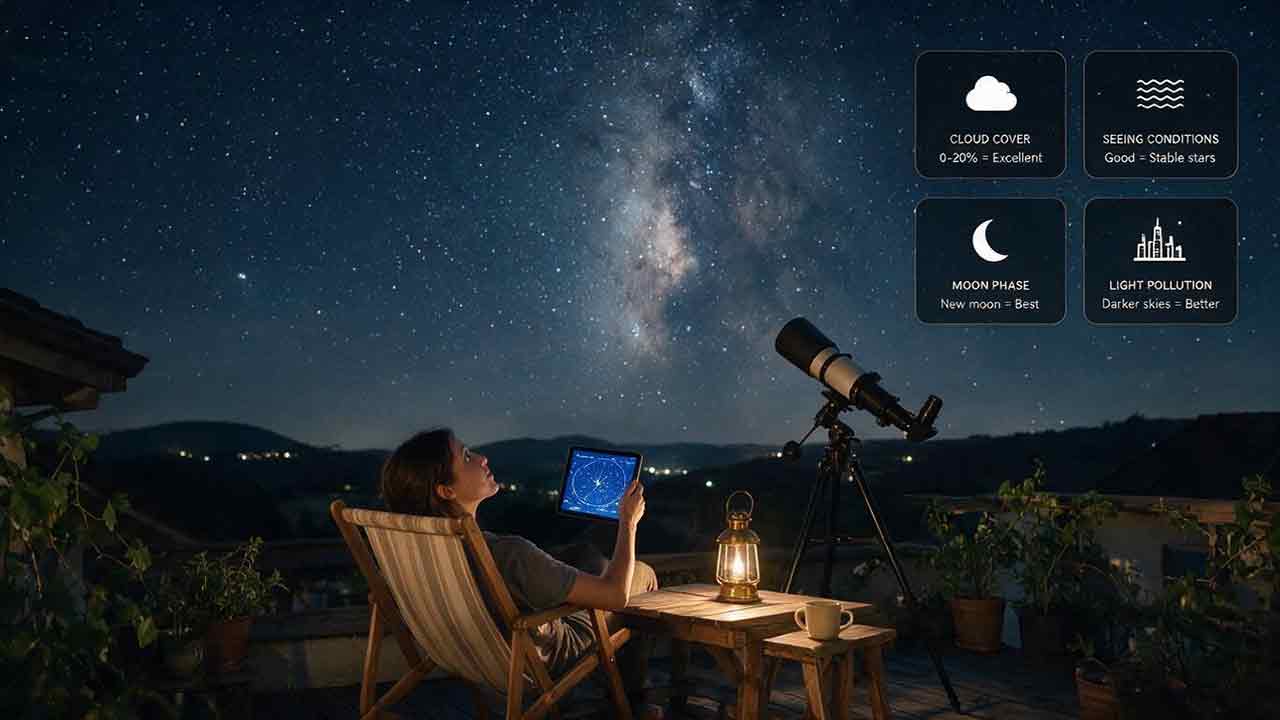
A useful stargazing forecast requires more than a clear-weather icon. This guide explains how to check hourly cloud cover, precipitation and lightning risk, atmospheric transparency, astronomical seeing, Moon position, twilight, target altitude, wind, dew, smoke, light pollution, and site access before deciding whether to observe. Readers will learn why a night can be excellent for planets but poor for galaxies, how to distinguish cloud cover from transparency and seeing, and how to match changing conditions to the Moon, Milky Way, meteor showers, clusters, double stars, and deep-sky objects. The article includes a 10-minute checking process, a CLEAR decision framework, a hypothetical worked example, forecast-tool comparisons, rescue strategies for marginal nights, troubleshooting advice, a complete checklist, and safety guidance for thunderstorms and hazardous travel.
How Clouds, Humidity, and Air Turbulence Affect Stargazing
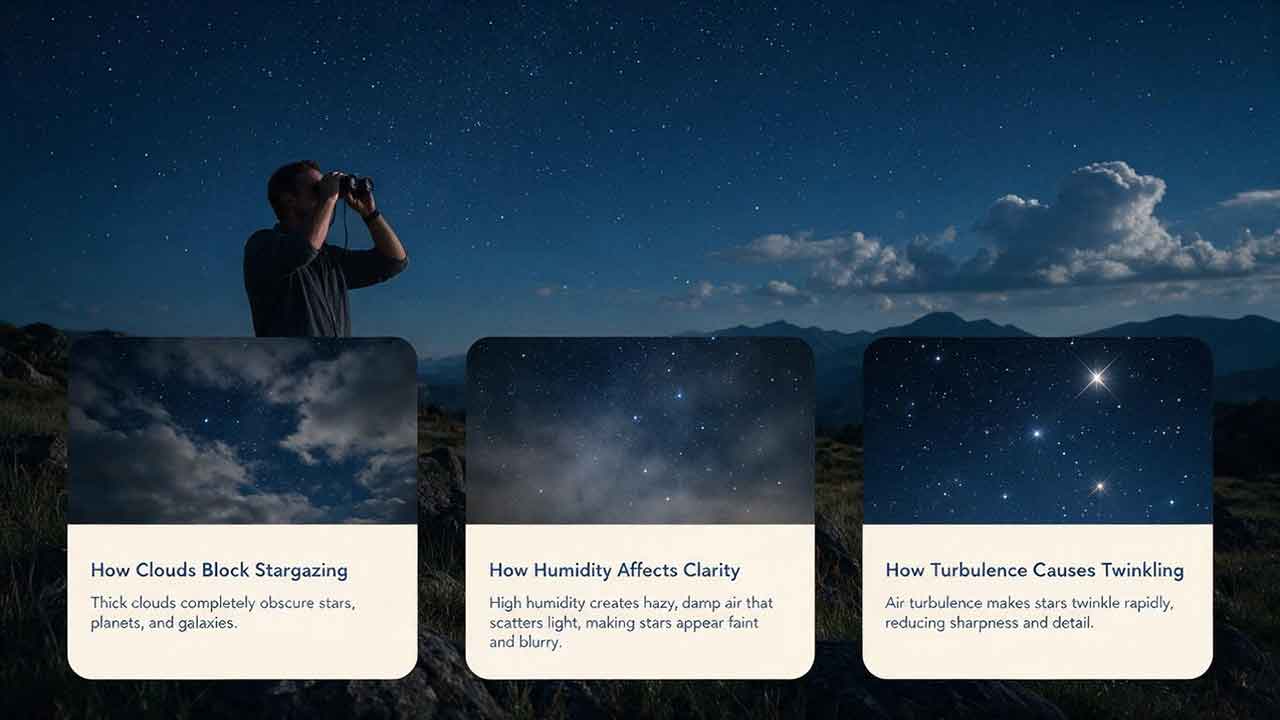
Clear skies do not always produce sharp telescope views, and high humidity does not automatically make a night unsuitable for astronomy. This practical guide separates cloud cover, transparency, moisture, dew risk, and atmospheric seeing so observers can diagnose conditions accurately. It explains how thin cirrus can weaken faint objects, why dew point is more useful than relative humidity alone for predicting condensation, and how turbulent air blurs planetary and lunar detail. The article introduces the original CAST planning framework—Clouds, Air moisture, Seeing, and Target—to help readers interpret forecasts and match each night to appropriate observing goals. A temperature–dew point calculation, target-selection tables, realistic observing scenarios, a go/change-target/cancel matrix, troubleshooting guide, and pre-session checklist turn weather data into practical decisions. Authoritative material from NASA, NOAA, the National Weather Service, the European Southern Observatory, and telescope-manufacturer documentation supports the scientific and equipment-care guidance.
How Long Does It Take Your Eyes to Adjust to Darkness?
Your eyes begin adapting to darkness within seconds, but useful night vision develops in stages. Pupil dilation happens quickly, cone sensitivity improves during the first several minutes, and rod-based sensitivity can continue increasing for roughly 20–40 minutes after strong light exposure. This guide explains how rods, cones, rhodopsin, glare, age, eye health, and previous lighting affect the timing. Readers will learn how to preserve dark adaptation with dim red light, use averted vision for faint targets, organize a safe observing site, and match the waiting period to the Moon, planets, star clusters, galaxies, nebulae, or meteor showers. The article also includes an ADAPT planning framework, a real-world observing timeline, a light-source comparison, troubleshooting guidance, a detailed checklist, and signs that persistent night-vision difficulty should be evaluated by an eye-care professional.
Explore More Topics
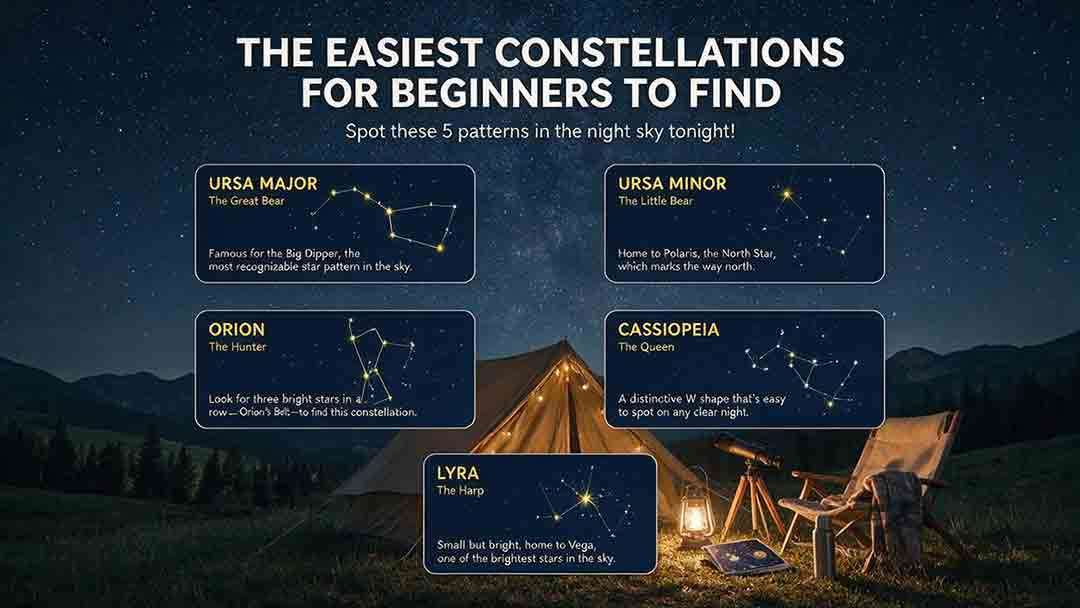
The Easiest Constellations for Beginners to Find
This beginner-friendly guide explains how to find Orion, Ursa Major through the Big Dipper, Cassiopeia, Cygnus, and Scorpius using clear naked-eye observing steps. It compares each pattern through an original Beginner Visibility Score and shows readers how to choose a first target based on season, latitude, light pollution, moonlight, and horizon visibility. The guide also clarifies the difference between constellations and asterisms, explains how the Big Dipper can point toward Polaris, and provides dedicated recommendations for Southern Hemisphere observers, including Crux. Practical tools include the Anchor-Pattern Method, the Three-Check Rule, a 10-minute observing session, city-sky guidance, troubleshooting advice, an equipment comparison, and a safety checklist. Authoritative references from the International Astronomical Union, NASA, NSF NOIRLab, and the European Southern Observatory support the key astronomical facts.
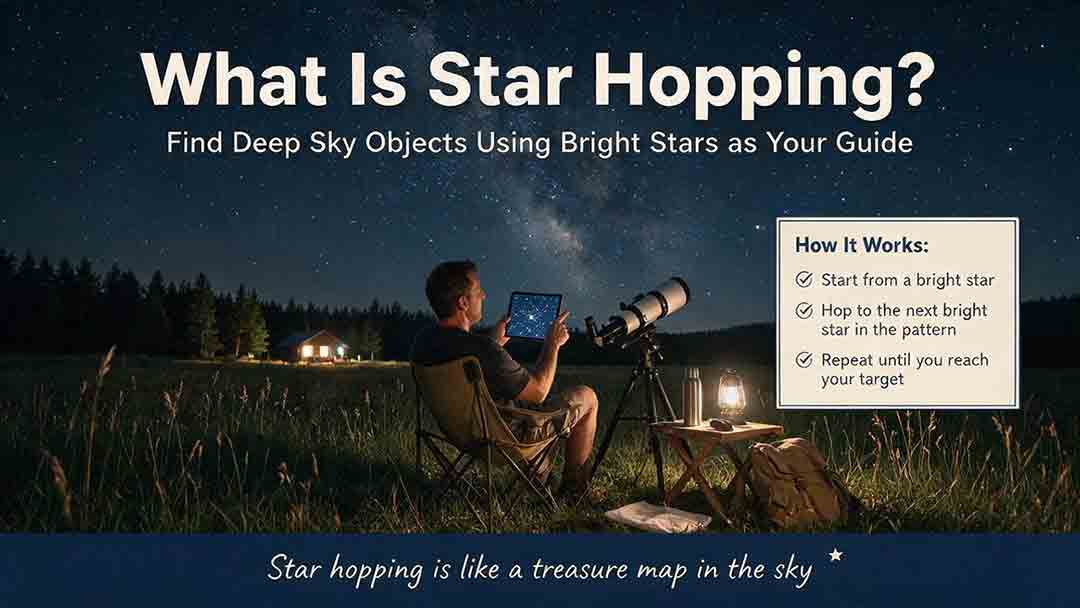
What Is Star Hopping and How Do You Do It?
Star hopping is a practical way to navigate the night sky by moving from a bright, recognizable star to a fainter target through a sequence of visible star patterns. This guide explains how beginners can plan a reliable route, align a finder, match a star chart to a telescope’s field of view, and recognize rotated or mirror-reversed images. It introduces the Anchor–Path–Field–Confirm method, provides a step-by-step observing process, and shows how field-of-view estimates can help determine a practical chart scale. A worked example demonstrates how to locate Messier 13 using the Keystone of Hercules, while the troubleshooting table addresses common problems such as finder misalignment, excessive magnification, incorrect chart orientation, and targets that remain invisible despite correct pointing. The included field checklist gives binocular and telescope users a repeatable method for planning and completing future star hops.
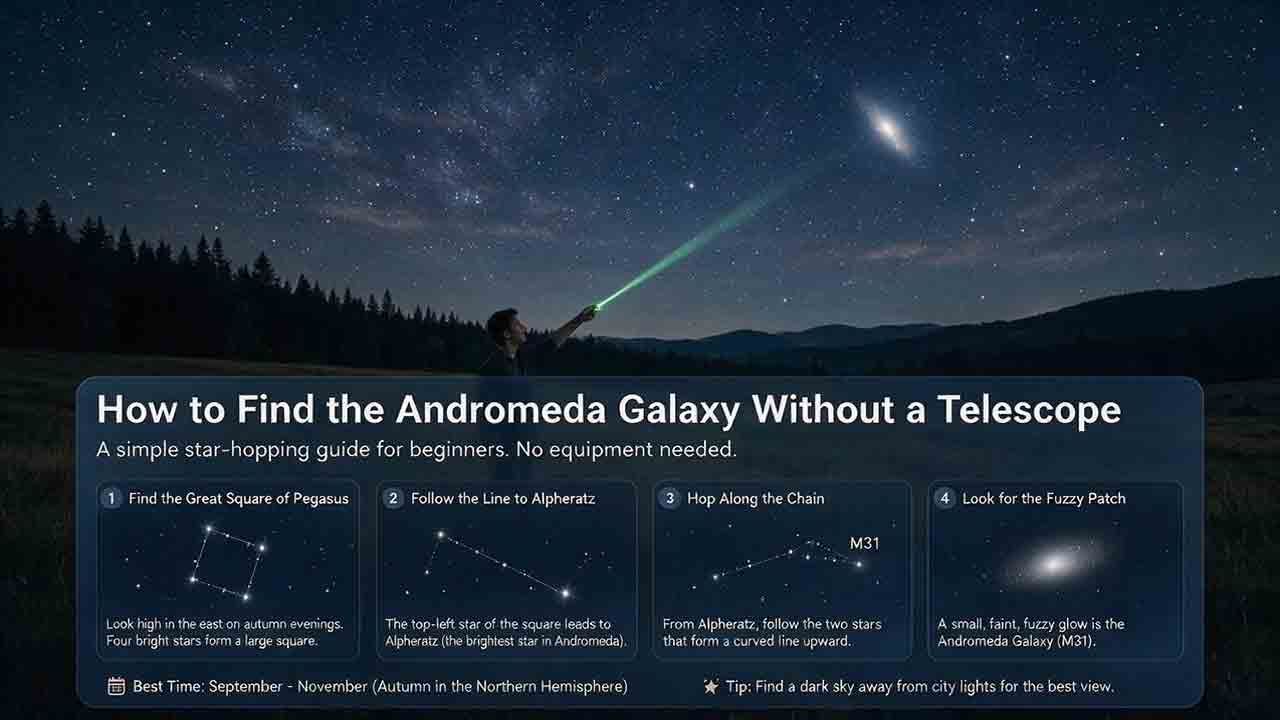
How to Find the Andromeda Galaxy Without a Telescope
Finding the Andromeda Galaxy without a telescope is possible when you know which stars to use as landmarks. This practical guide explains how to start at the Great Square of Pegasus, identify Alpheratz, follow the Andromeda star chain to Mirach, and use two nearly equal short hops to reach Mu Andromedae and M31. It also explains what the galaxy realistically looks like to the naked eye, why dark skies and averted vision matter, and how binoculars can help confirm the target. Beginners can use the six-point observing checklist, three-night practice method, troubleshooting guidance, and reusable observation log to improve each attempt. The guide distinguishes calculated angular distances from practical field estimates and clearly explains its source-checking process without claiming personal testing. It is designed primarily for Northern Hemisphere observers while also addressing visibility limitations from Southern Hemisphere locations.