The Easiest Constellations for Beginners to Find

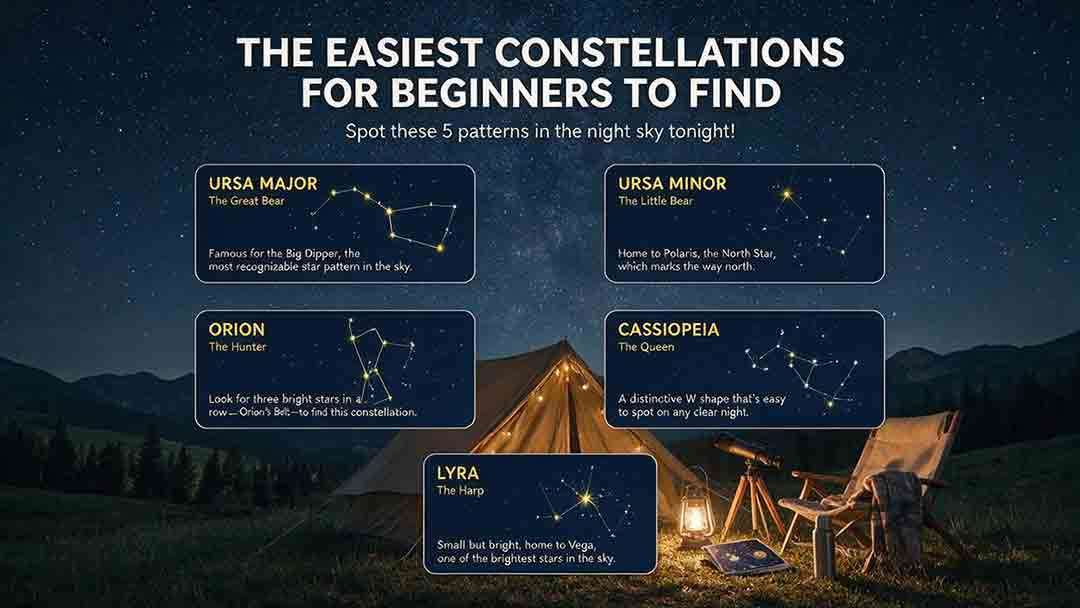
The easiest constellations for beginners to find are Orion, Ursa Major through the Big Dipper, Cassiopeia, Cygnus, and Scorpius. Orion is usually the clearest first target during its season, while the Big Dipper is especially useful for learning northern sky navigation. Your best starting point depends on latitude, season, local time, light pollution, moonlight, and horizon obstructions.
Key Takeaways
- Orion is usually the easiest first visual target because its three-star belt is bright and distinctive.
- The Big Dipper is an asterism within Ursa Major, not an official constellation by itself.
- Cassiopeia is a practical northern alternative because its five main stars form a recognizable W or M.
- Cygnus and Scorpius are useful summer targets, but they are more sensitive to city glow and blocked horizons.
- Beginners learn faster by finding one anchor pattern, confirming two supporting features, and then locating it again without an app.
This guide explains which constellation to choose, how to identify it step by step, what may remain visible from a city, and how to diagnose the most common constellation-finding problems.
Scope note: The main seasonal recommendations are written for observers at mid-northern latitudes. Southern Hemisphere beginners will often find Orion, Scorpius, Crux, and Centaurus more practical than far-northern patterns.
Which Are the Easiest Constellations for Beginners to Find Tonight?
The easiest target is not necessarily the most famous one. It is the pattern that is above your horizon, visible from your latitude, clear of obstructions, and recognizable under your local sky conditions.
| Observing situation | Best first target | Why it works |
|---|---|---|
| Northern Hemisphere winter evening | Orion | Bright belt and clear surrounding stars |
| Northern Hemisphere spring evening | Big Dipper in Ursa Major | Large familiar pattern with navigation value |
| Northern Hemisphere autumn evening | Cassiopeia | Compact W-shaped northern pattern |
| Northern Hemisphere summer evening | Cygnus | Northern Cross and bright Deneb |
| Mid-year with an open southern horizon | Scorpius | Reddish Antares and a curved body |
| Southern Hemisphere | Orion, Scorpius, or Crux | More practical than far-northern patterns |
| Bright city sky | Orion, Big Dipper, or Cassiopeia | Their main anchors use relatively bright stars |
No constellation is easiest everywhere. A current star chart or astronomy app should confirm whether your chosen target is above the horizon before you begin searching.
What Is the Difference Between a Constellation and an Asterism?
A constellation is an officially defined region of the celestial sphere. An asterism is a recognizable star pattern that may lie inside one constellation or combine stars from several constellations.
The International Astronomical Union recognizes 88 official constellations, and those regions together cover the entire sky. The familiar connecting lines shown on star charts are teaching aids rather than official scientific boundaries.
Several common beginner patterns are asterisms:
- The Big Dipper is a seven-star pattern within Ursa Major.
- The Northern Cross is a recognizable pattern within Cygnus.
- The Summer Triangle combines Vega, Deneb, and Altair from three different constellations.
- Orion’s three-star belt is a small anchor pattern within Orion.
This distinction matters because beginners usually recognize a simple asterism before they can trace the larger official constellation around it.
How Were the Easiest Constellations Rated?
The Beginner Visibility Score is an editorial comparison created for this guide. It evaluates five qualities that affect a first naked-eye observation:
- Anchor brightness: How strongly the key stars stand out.
- Shape clarity: How distinctive the pattern appears.
- City resilience: How much of the anchor may survive moderate light pollution.
- Seasonal practicality: How useful the target is during its main season.
- Navigation value: Whether the pattern helps locate another star or sky region.
Each quality receives up to four points, for a possible total of 20.
These scores are teaching comparisons, not scientific measurements, visibility probabilities, success rates, or results from a controlled observing experiment. Actual visibility varies with location, weather, moonlight, eyesight, local lighting, and obstructions.
| Pattern | Score | Best for | Main limitation |
|---|---|---|---|
| Orion | 18/20 | First visual recognition | Seasonal |
| Big Dipper | 18/20 | Northern navigation | Not practical from much of the Southern Hemisphere |
| Cassiopeia | 18/20 | Northern sky orientation | Less visually dominant than Orion |
| Cygnus | 14/20 | Summer Milky Way exploration | Part of the cross may disappear in city glow |
| Scorpius | 14/20 | Low northern latitudes and southern observers | Often low in the northern sky |
The three highest-scoring patterns are tied intentionally. Orion is the strongest visual introduction, the Big Dipper is the most useful northern guide, and Cassiopeia is a dependable northern alternative.
1. How Do You Find Orion?
Orion is usually the easiest constellation for a complete beginner to recognize during its visible season. Start with Orion’s Belt rather than trying to match the entire hunter figure shown in illustrations.
Orion’s Belt consists of Alnitak, Alnilam, and Mintaka, three stars arranged in a short, nearly straight line. Reddish-orange Betelgeuse and blue-white Rigel provide two additional confirmation points.
NASA describes Orion as one of the most recognizable constellations and identifies its belt, Betelgeuse, and Rigel as prominent features. See the official NASA Orion constellation reference.
How to Find Orion Step by Step
- Check a current chart to confirm that Orion is above your horizon.
- Scan a wide area for three similarly bright stars in a short line.
- Look around the belt for four brighter stars forming a rough rectangle or hourglass.
- Identify reddish-orange Betelgeuse on one side of the belt.
- Identify bright Rigel on the opposite side.
- Put the chart away and locate the belt again.
From mid-northern latitudes, Orion is prominent during winter evenings. Southern Hemisphere observers can also see it during their summer, although its apparent orientation may look unfamiliar.
What Parts of Orion May Be Visible From a City?
Under city lighting, the belt may remain easy to recognize even when Orion’s fainter stars disappear.
A city observer may see:
- All three belt stars
- Betelgeuse
- Rigel
- One or two additional corner stars
You do not need to trace every line shown on a star map. Orion’s Belt plus Betelgeuse and Rigel is a stronger confirmation than the traditional hunter outline.
Orion’s Main Limitation
Orion is seasonal. When an astronomy app shows it below the horizon or close to the Sun’s position, the problem is timing rather than your ability to recognize the pattern.
2. How Do You Find Ursa Major Through the Big Dipper?
The easiest way to recognize Ursa Major is to find the seven-star Big Dipper asterism. Four stars form its bowl, while three more create a bent handle.
The official Ursa Major constellation covers a much larger region. Under suburban or city skies, the Big Dipper may be obvious even when the rest of Ursa Major is difficult or impossible to trace.
How to Find the Big Dipper
- Face an open section of the northern sky.
- Search for four stars forming a broad bowl.
- Look for three additional stars curving away as a handle.
- Compare the relative spacing of the stars.
- Do not expect the dipper to appear upright.
The Big Dipper may look sideways, tilted, upright, or inverted. Its orientation changes with the season and time of night.
How Do You Use the Big Dipper to Find Polaris?
- Use a chart to identify Merak and Dubhe, the two stars on the outer edge of the bowl.
- Draw an imaginary line from Merak through Dubhe.
- Extend that line approximately five times the distance between the two stars.
- The moderately bright star near the end of the line is Polaris.
NASA’s guide to finding the North Star explains how the Big Dipper’s pointer stars lead toward Polaris.
Polaris is not the brightest star in the night sky. It is useful because it lies close to the north celestial pole and therefore remains in approximately the same northern direction as other stars appear to move around it.
For a more detailed route, continue with How to Find the North Star.
When Is the Big Dipper Difficult to See?
The Big Dipper is visible during much or all of the year from many mid- and high-northern locations, but its height changes.
It may be difficult when:
- It is close to the horizon
- Buildings, hills, or trees block the north
- Haze brightens the horizon
- The observer is at a low northern latitude
- The observer is far into the Southern Hemisphere
Merak should not be described as permanently below Dubhe, and Dubhe should not be described as permanently above Merak. The entire pattern rotates in the observer’s view.
Navigation caution: Polaris is useful for basic sky orientation, but it should not replace a map, compass, GPS device, marked route, or emergency locator.
3. How Do You Find Cassiopeia?
Cassiopeia is easiest to recognize as five moderately bright stars forming a wide W, M, or uneven zigzag. It is one of the most useful northern anchor patterns because its basic geometry remains recognizable as its orientation changes.
How to Find Cassiopeia Step by Step
- Look toward the northern part of the sky.
- Search for five stars arranged in a broad zigzag.
- Compare the spacing and angles between the stars.
- Do not reject the pattern because it resembles an M instead of a W.
- Confirm its position relative to Polaris with a current chart.
- Look away and find it again without assistance.
Cassiopeia and the Big Dipper occupy different sides of the polar region. At certain times, Cassiopeia will be high and easy to see while the Big Dipper is low or obstructed.
Why Is Cassiopeia Useful for Star Hopping?
Cassiopeia is a practical starting point for exploring Perseus, Cepheus, and the broader region toward Andromeda.
Once the W shape is familiar, it can support the route described in How to Find the Andromeda Galaxy Without a Telescope.
Cassiopeia’s Main Limitation
Cassiopeia’s main stars are not as visually dominant as Orion’s brightest stars. Thin cloud, moonlight, or severe light pollution may reduce the W to only three or four obvious points.
When the pattern looks incomplete, compare the visible star spacing with a chart instead of waiting for a perfect letter shape.
4. How Do You Find Cygnus and the Northern Cross?
Cygnus is easiest to recognize through the Northern Cross, an asterism formed by several of the constellation’s brightest stars. It is a useful Northern Hemisphere target during summer and early autumn.
Deneb marks one end of the long axis. Sadr lies near the cross’s center, while Albireo lies toward the opposite end. Deneb is also one corner of the Summer Triangle.
NSF NOIRLab identifies Deneb as the brightest star in Cygnus and Albireo as another prominent member of the constellation. See its official Cygnus constellation guide.
How to Find Cygnus Step by Step
- Locate the Summer Triangle, formed by Vega, Deneb, and Altair.
- Identify Deneb as one of the triangle’s three corners.
- Look from Deneb toward Sadr near the center of the Northern Cross.
- Continue along the same general line toward Albireo.
- Look for the shorter crossbar passing through the central region.
- Use the stars Gienah and Delta Cygni to help confirm the crossbar.
- Compare the full pattern with a current chart.
A complete beginner does not need to memorize every star name. Deneb, Sadr, and Albireo provide useful checkpoints that make the route more precise.
What Parts of Cygnus May Be Visible From a City?
Deneb may be obvious while only part of the Northern Cross remains visible.
When the cross seems incomplete:
- Block direct streetlight glare with a wall or building.
- Give your eyes time to adjust.
- Confirm the Summer Triangle first.
- Look slightly beside a faint star rather than directly at it.
- Observe when Cygnus is higher above the horizon.
Cygnus lies in a star-rich part of the Milky Way. Under dark skies, this creates an impressive background. Under city skies, the loss of fainter stars can make the complete swan-shaped outline harder to interpret.
Cygnus’s Main Limitation
The Northern Cross covers a larger area than many beginners expect. It may also appear sideways or inverted, so relative spacing is more useful than page orientation.
5. How Do You Find Scorpius?
Scorpius is easiest to locate by finding reddish-orange Antares and following the constellation’s curved body toward its hooked tail. It is prominent during Northern Hemisphere summer evenings and Southern Hemisphere winter evenings.
How to Find Scorpius Step by Step
- Check that Scorpius is above your horizon.
- From the Northern Hemisphere, examine the southern sky.
- Use a current chart to find and confirm reddish-orange Antares.
- Look for a chain of stars curving away from Antares.
- Continue along the curve toward the hooked tail.
- Confirm part of the upper body and tail before accepting the full pattern.
Antares is a helpful color anchor, but color alone is not enough. Mars and other reddish objects can occasionally appear in the same general region, so the surrounding stars must also match.
Why Can Scorpius Be Easy and Difficult?
When the complete constellation is visible, its long curve looks more convincing than many traditional constellation outlines.
However, Scorpius stays low in the southern sky for many mid- and high-northern observers. Its lower stars may be hidden by:
- Buildings
- Trees
- Hills
- Atmospheric haze
- Bright horizon lighting
- The observer’s latitude
Seeing Antares does not guarantee that the hooked tail will also be visible.
Who Should Choose Scorpius First?
Scorpius is especially practical for:
- Southern Hemisphere beginners
- Observers at low northern latitudes
- People with a clear southern horizon
- Mid-year observing sessions
It is usually a weaker first target for someone at a high northern latitude or in a city with a blocked southern view.
Which Constellations Are Best in the Southern Hemisphere?
Southern Hemisphere beginners should usually prioritize Orion, Scorpius, and Crux, with Centaurus becoming useful once the basic southern sky is familiar.
| Southern observing situation | Recommended starting pattern |
|---|---|
| Summer evening | Orion |
| Winter evening | Scorpius |
| Learning southern orientation | Crux |
| Near-equatorial location | Orion or Scorpius |
| Bright urban sky | Orion first |
| Ready to explore around Crux | Centaurus |
How Do You Confirm the Real Southern Cross?
Crux is a small official constellation, commonly called the Southern Cross. Because nearby stars can form misleading cross-like shapes, do not identify Crux from shape alone.
Use this confirmation sequence:
- Find a compact four-star cross.
- Locate the nearby bright stars Alpha Centauri and Beta Centauri.
- Confirm that these two Pointer Stars direct attention toward the Crux region.
- Compare the cross’s size and orientation with a current chart.
- Make sure you have not selected the larger nearby pattern commonly called the False Cross.
The European Southern Observatory explains how Alpha Centauri and Beta Centauri help observers locate Crux.
Crux’s long axis can indicate the approximate direction of the south celestial pole, but no similarly bright star marks that pole in the way Polaris marks the northern region. The method should be treated as general sky orientation rather than precise or emergency navigation.
Crux is not equally placed for every Southern Hemisphere observer. Its height and the length of time it remains visible depend on latitude, date, and local time.
What Is the Anchor-Pattern Method?
The Anchor-Pattern Method is a three-stage process for learning constellations without trying to memorize an entire star chart.
Step 1: Find One Memorable Anchor
Begin with the smallest distinctive pattern:
- Orion: three-star belt
- Ursa Major: Big Dipper bowl and handle
- Cassiopeia: five-star zigzag
- Cygnus: Northern Cross
- Scorpius: Antares and the curve
- Crux: compact cross
Step 2: Confirm Two Supporting Features
Do not accept a vague resemblance. Find at least two additional checks:
- Orion’s Belt plus Betelgeuse and Rigel
- Big Dipper bowl plus the curved handle
- Cassiopeia’s central point plus both outer arms
- Deneb plus Sadr and Albireo
- Antares plus part of Scorpius’s tail
- Crux plus Alpha and Beta Centauri
This is the Three-Check Rule: one anchor plus two supporting features.
Step 3: Find the Pattern Again Without Help
Lower the phone or put away the chart for about 30 seconds. Look elsewhere, then return to the same part of the sky and identify the anchor again.
This final repetition distinguishes genuine recognition from temporarily following a screen.
Example: Confirming Orion
A suburban observer notices three aligned stars, then confirms Betelgeuse and Rigel on opposite sides of the belt. After checking a chart, the observer lowers the phone and finds the belt again. This is a hypothetical teaching example, not a report of a controlled field test.
Once one anchor becomes familiar, use it as the starting point for What Is Star Hopping and How Do You Do It?
What Should You Do During Your First 10-Minute Session?
A short session focused on one pattern is usually more useful than trying to memorize several constellations.
Minute 0–2: Choose One Target
Check:
- Your hemisphere and approximate latitude
- The current season
- Local time
- Your clearest horizon
- Moon brightness
- Nearby artificial lighting
- Whether the target is above the horizon
Select one constellation only.
Minute 2–5: Find the Anchor
Search for the target’s most distinctive geometric feature rather than its complete mythological figure.
Keep your field of view wide. Constellations usually occupy much more sky than a phone screen or book illustration suggests.
Minute 5–7: Confirm the Pattern
Use a paper chart or astronomy app to check:
- General direction
- Relative star spacing
- Pattern orientation
- Supporting stars
- Position above the horizon
Lower the screen brightness and use a red night mode when available.
For help interpreting chart orientation, see How to Read a Star Chart.
Minute 7–10: Repeat Without Assistance
Put the chart away and locate the same anchor again. Then describe its shape and location in your own words.
A successful first session does not require memorizing every star name. Finding the same anchor twice is enough.
What Can You See From a City?
Artificial skyglow raises the brightness of the background sky and reduces the contrast of faint stars. NSF NOIRLab explains how light pollution reduces night-sky visibility.
Under city lighting, you may see:
- Orion’s Belt without Orion’s fainter stars
- The seven main Big Dipper stars without the larger Ursa Major outline
- Most of Cassiopeia’s W
- Deneb and only part of the Northern Cross
- Antares without the complete tail of Scorpius
- The brighter stars of Crux without much of the surrounding Milky Way
If only a small number of stars are visible, begin with Orion, the Big Dipper, or Cassiopeia rather than trying to trace a large pattern that depends on several faint stars.
How Can You Improve Urban Visibility?
- Stand where a wall or building blocks direct glare.
- Avoid bright screens before and during observation.
- Lower your phone’s brightness.
- Give your eyes time to adjust.
- Observe when the target is higher above the horizon.
- Choose a clear night with less haze.
- Avoid beginning with a faint target near a bright Moon.
A remote dark-sky site is not required for learning your first constellation. Darker skies become more important when you want to see the Milky Way, faint constellation members, nebulae, or galaxies.
Why Can’t You Find the Constellation?
| What you see | Likely cause | Practical response |
|---|---|---|
| No recognizable pattern | Wrong season, time, or direction | Check a location-aware chart |
| Only one or two bright stars | Light pollution, moonlight, haze, or cloud | Choose a brighter anchor |
| Pattern looks rotated | Normal sky motion and viewing angle | Compare spacing rather than “up” and “down” |
| App points to the wrong area | Compass interference or incorrect settings | Recalibrate away from metal objects |
| Target is partly hidden | Buildings, hills, trees, or low altitude | Move safely or choose a higher target |
| Stars vanish after checking the phone | Screen light reduced dark adaptation | Lower brightness and use red mode |
| Stars fade in and out | Cloud, smoke, haze, or moisture | Wait for clearer conditions |
| Chart shows far more stars | The chart displays stars too faint for your sky | Reduce its limiting magnitude |
A constellation-finding problem is often a timing, orientation, or visibility problem—not a failure to understand astronomy.
What Mistakes Make Constellations Harder to Learn?
Trying to Match the Mythological Figure
Most constellations do not look convincingly like their traditional people, animals, or objects.
Learn the geometric anchor first. Treat the artwork as cultural interpretation rather than a literal observing diagram.
Expecting the Pattern to Stay Upright
A W can become an M. A dipper can appear sideways. A cross can look inverted.
The relative spacing between the stars remains useful even when the entire pattern changes orientation.
Using a Telescope Too Soon
A telescope shows a narrow portion of the sky. This is useful for examining selected objects but inconvenient for learning large constellation patterns.
Use unaided vision first. Binoculars and telescopes become more useful after you know which region you are exploring.
Following an App Without Studying the Stars
An app can confirm a direction, but repeatedly moving a phone around does not automatically build sky recognition.
Check the screen, study the actual star spacing, put the phone down, and repeat the search.
Learning Too Many Patterns at Once
One familiar constellation becomes a permanent reference point. Five briefly viewed patterns are less likely to become useful memories.
Add another constellation after you can find the first without help.
Ignoring Latitude and Horizon Obstructions
A constellation described as easy may still be below your horizon or hidden behind a building.
Local sky geometry can matter more than the constellation’s general reputation.
Do You Need Any Equipment?
No telescope is required to find the constellations in this guide.
| Tool | Best use | Main limitation |
|---|---|---|
| Unaided eyes | Recognizing complete patterns | Faint stars disappear under bright skies |
| Printed chart | Learning without screen glare | Must match your season and location |
| Astronomy app | Confirming real-time position | Compass errors and bright screens |
| Binoculars | Exploring targets after identification | Narrower view than unaided vision |
| Telescope | Examining individual objects | Usually too narrow for whole constellations |
For a first observing session, your unaided eyes and a simple chart are enough.
Beginner Observation Checklist
Before going outside:
- Choose one constellation suitable for the season.
- Confirm that it is above the horizon.
- Know which general direction to face.
- Identify its main anchor pattern.
- Choose a legal and accessible observing location.
- Reduce your screen brightness.
- Prepare for the temperature and weather.
- Plan to locate the pattern a second time without help.
The checklist does not guarantee visibility. It removes common preventable obstacles.
How Can You Observe Safely?
Constellation observing is generally low risk, but nighttime surroundings require ordinary precautions.
- Use a legal public location or obtain the landowner’s permission.
- Do not stop on road shoulders or stand near moving traffic.
- Avoid restricted property, rooftops, construction zones, and unstable terrain.
- Watch for holes, steps, water, wildlife, and changing weather.
- Carry a small flashlight and appropriate clothing.
- Supervise children near roads, water, or uneven ground.
- Tell someone where you are going when visiting an isolated location.
- Do not use stars as your only navigation method while hiking, boating, driving, or handling an emergency.
The darkest observing site is not automatically the best beginner site. A slightly brighter location with safe access, firm ground, and an open view is often the better choice.
Where Should You Start Tonight?
Choose Orion when it is visible and you want the clearest first visual success.
Choose the Big Dipper when you are in the Northern Hemisphere and want to learn how one star pattern can guide you toward another.
Choose Cassiopeia when your northern sky is open but the Big Dipper is low or blocked.
Choose Cygnus during northern summer if you want an anchor for exploring the Summer Triangle and the Milky Way region.
Choose Scorpius if you have a clear southern horizon, especially from a low northern latitude or the Southern Hemisphere.
Choose Crux when learning southern sky orientation, but confirm it with Alpha Centauri and Beta Centauri rather than accepting the first cross-like pattern you notice.
After your first success, return on another night and find the same pattern in a different orientation. That second observation will teach you more about the moving sky than memorizing another long list of names.
Frequently Asked Questions
What is the easiest constellation to see from a city?
Orion, the Big Dipper, and Cassiopeia are usually the strongest city-sky choices because their main anchors contain relatively bright stars. The best option still depends on season, latitude, moonlight, weather, and horizon obstructions.
Can you see constellations during a full moon?
Yes, but moonlight raises the brightness of the sky and hides fainter stars. Major patterns such as Orion’s Belt or the Big Dipper may remain visible while the full outlines of Cygnus or Scorpius become harder to trace.
Why does a constellation look sideways or upside down?
Its apparent orientation changes with the time of night, season, latitude, and direction you are facing. Compare relative star spacing rather than expecting the pattern to match the orientation printed on a chart.
What is the easiest constellation in the Southern Hemisphere?
Orion is one of the easiest broad patterns during its visible season. Scorpius is another strong mid-year choice, while Crux is useful for learning southern sky orientation.
How long does it take to learn one constellation?
A beginner may recognize a strong anchor during one session, but reliable identification usually requires finding it again on later nights and in different orientations. Repetition matters more than memorizing every star name.
Do you need binoculars to find constellations?
No. Constellations are usually easier to recognize with unaided vision because binoculars show a smaller area of sky. Binoculars are more useful after you have identified the surrounding constellation.
Sources
International Astronomical Union — The Constellations
Official constellation regions, the 88 recognized constellations, and the distinction between constellations and asterisms.NASA Science — What Is the North Star and How Do You Find It?
Polaris, the north celestial pole, and the Big Dipper pointer-star method.NASA Science — Orion Constellation
Orion’s Belt, Betelgeuse, Rigel, and Orion’s prominence in the winter sky.NSF NOIRLab — Cygnus
Deneb, Albireo, and Cygnus as the Northern Cross.NSF NOIRLab — Light Pollution
How artificial skyglow reduces night-sky visibility.European Southern Observatory — Navigating the Stars: The Southern Cross
Crux and the use of Alpha Centauri and Beta Centauri as the Pointer Stars.
How This Guide Was Reviewed
This article was checked against official constellation definitions from the International Astronomical Union, NASA skywatching resources, NSF NOIRLab constellation and light-pollution material, and European Southern Observatory guidance for Crux.
The seasonal recommendations describe broad observing patterns rather than universal visibility guarantees. A constellation’s actual position depends on latitude, longitude, date, local time, weather, moonlight, terrain, and artificial lighting.
The Beginner Visibility Score, Three-Check Rule, Anchor-Pattern Method, and 10-minute session are editorial teaching tools created for this guide. They are not scientific measurements, controlled test results, or guarantees that every observer will have the same experience.
This guide is based on authoritative references and practical observing criteria rather than unpublished experiments or hands-on product testing.
More from Constellations & Star Hopping
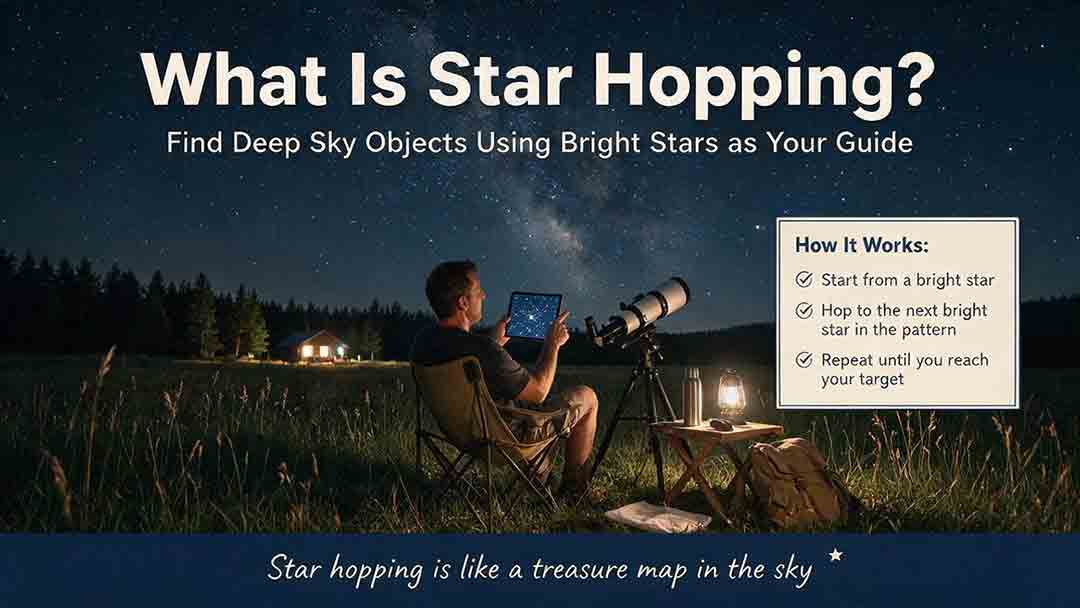
What Is Star Hopping and How Do You Do It?
Star hopping is a practical way to navigate the night sky by moving from a bright, recognizable star to a fainter target through a sequence of visible star patterns. This guide explains how beginners can plan a reliable route, align a finder, match a star chart to a telescope’s field of view, and recognize rotated or mirror-reversed images. It introduces the Anchor–Path–Field–Confirm method, provides a step-by-step observing process, and shows how field-of-view estimates can help determine a practical chart scale. A worked example demonstrates how to locate Messier 13 using the Keystone of Hercules, while the troubleshooting table addresses common problems such as finder misalignment, excessive magnification, incorrect chart orientation, and targets that remain invisible despite correct pointing. The included field checklist gives binocular and telescope users a repeatable method for planning and completing future star hops.
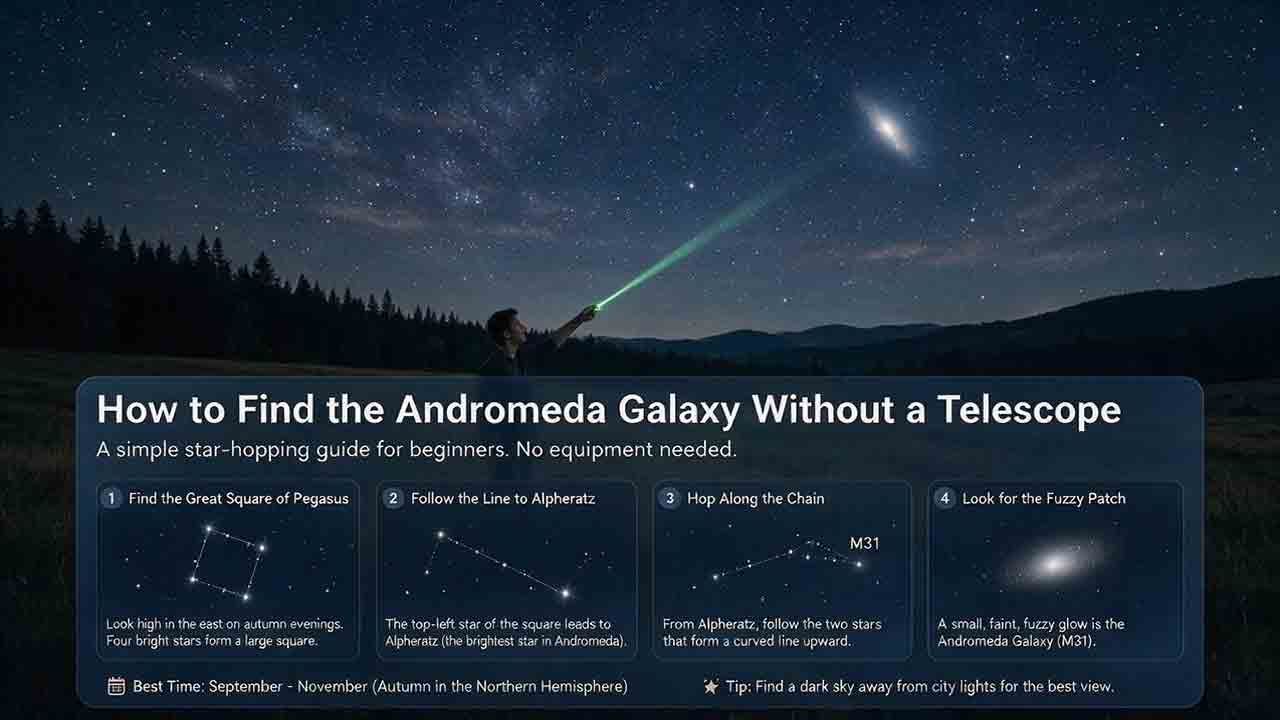
How to Find the Andromeda Galaxy Without a Telescope
Finding the Andromeda Galaxy without a telescope is possible when you know which stars to use as landmarks. This practical guide explains how to start at the Great Square of Pegasus, identify Alpheratz, follow the Andromeda star chain to Mirach, and use two nearly equal short hops to reach Mu Andromedae and M31. It also explains what the galaxy realistically looks like to the naked eye, why dark skies and averted vision matter, and how binoculars can help confirm the target. Beginners can use the six-point observing checklist, three-night practice method, troubleshooting guidance, and reusable observation log to improve each attempt. The guide distinguishes calculated angular distances from practical field estimates and clearly explains its source-checking process without claiming personal testing. It is designed primarily for Northern Hemisphere observers while also addressing visibility limitations from Southern Hemisphere locations.
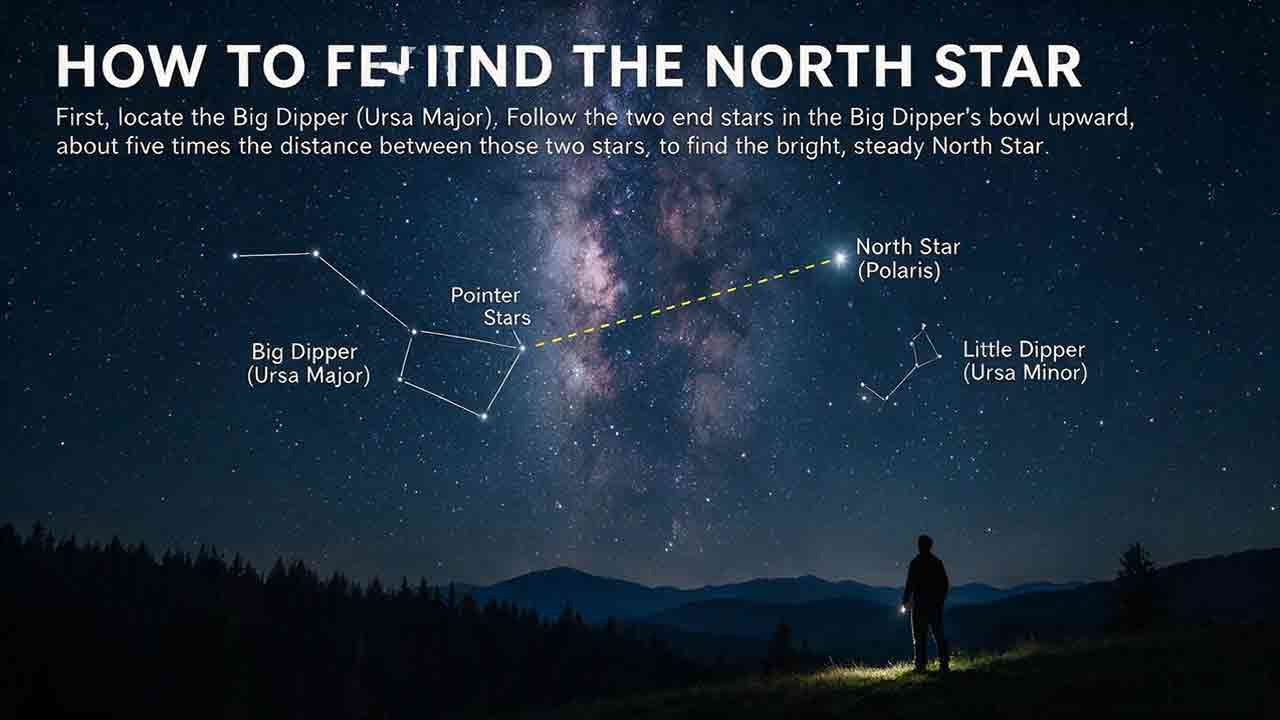
How to Find the North Star
Finding the North Star becomes straightforward once you know how to use the Big Dipper’s two pointer stars, Merak and Dubhe. This practical guide walks beginners through the complete process of locating Polaris, confirming it by position and latitude, and avoiding common mistakes such as choosing the brightest star or following the pointer line in the wrong direction. It also explains why Polaris appears nearly stationary, how its altitude relates approximately to an observer’s northern latitude, and why the full Little Dipper may be difficult to see under city skies. Readers will find troubleshooting advice for haze, light pollution, blocked horizons, misleading astronomy apps, and compass differences caused by magnetic declination. The article also includes a quick confirmation checklist, viewing-condition comparisons, an observation log, and a seven-step field routine. Clear safety guidance explains that Polaris is useful for approximate orientation but should not replace proper navigation tools.
Explore More Topics

How to Stay Warm and Comfortable During Winter Stargazing
Winter stargazing requires more preparation than wearing one heavy coat because observers often remain nearly motionless for long periods. This guide explains how to check temperature, wind chill, road conditions, snow, and shelter before leaving; build a moisture-managing base, insulating middle, and wind-resistant outer layer; and protect hands, feet, head, face, chair, and ground contact. Readers will learn how to combine liner gloves with mittens, avoid sweat, plan warm-up breaks, use heated clothing safely, manage food and hydration, protect batteries, and prevent condensation when cold equipment returns indoors. The article also includes the WARMER planning framework, clothing and glove comparisons, a three-hour worked example, cold-stress warning signs, troubleshooting guidance, departure rules, FAQs, and a complete winter stargazing checklist.
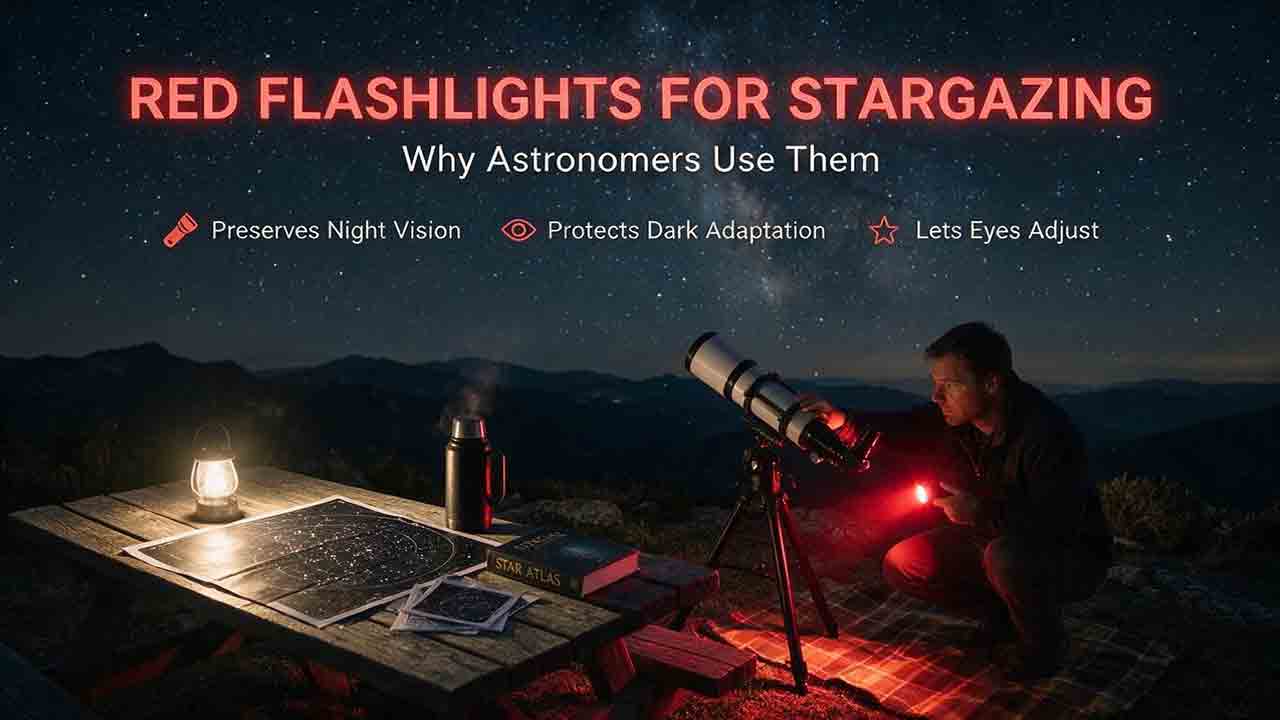
Red Flashlights for Stargazing: Why Astronomers Use Them
Astronomers use dim red flashlights because dark-adapted rod vision is less sensitive to long-wavelength red light than to much of the visible spectrum. A controlled red beam can illuminate charts, eyepieces, cables, and walking paths while causing less disruption than a typical white flashlight. This guide explains how rods, cones, rhodopsin, wavelength, brightness, exposure time, and beam direction shape the result. Readers will learn why red light is not harmless, how to compare handheld lights and headlamps, which product features prevent accidental white-light activation, how to configure a phone screen, and when safety requires a white emergency light. The article also includes the RED-SAFE buying framework, a task-lighting table, a worked observing example, DIY filter guidance, star-party etiquette, troubleshooting advice, FAQs, and complete purchase and field-use checklists.

Stargazing While Camping: A Practical Planning Guide
Camping can provide long, convenient access to dark skies, but a successful astronomy trip requires more than choosing the darkest location on a map. This guide explains how to combine campground rules, weather, Moon timing, food storage, wildlife protection, quiet hours, power, dew control, and telescope setup into one workable plan. It introduces the original CAMP framework—Confirm access, Align conditions, Map functional zones, and Prepare fallbacks—plus a three-zone campsite layout separating sleeping, service, and observing areas. Readers can compare developed, walk-in, backcountry, dispersed, and astronomy-focused campgrounds; build a night schedule from daylight arrival through morning pack-up; and use practical decision tables for Moonlight, cloud, wind, dew, neighboring lights, and campfire impacts. The article also includes a hypothetical two-night family plan, a go/modify/cancel decision tree, troubleshooting guidance, and a complete campsite checklist grounded in NASA, National Park Service, and National Weather Service resources.