How to Find the Andromeda Galaxy Without a Telescope

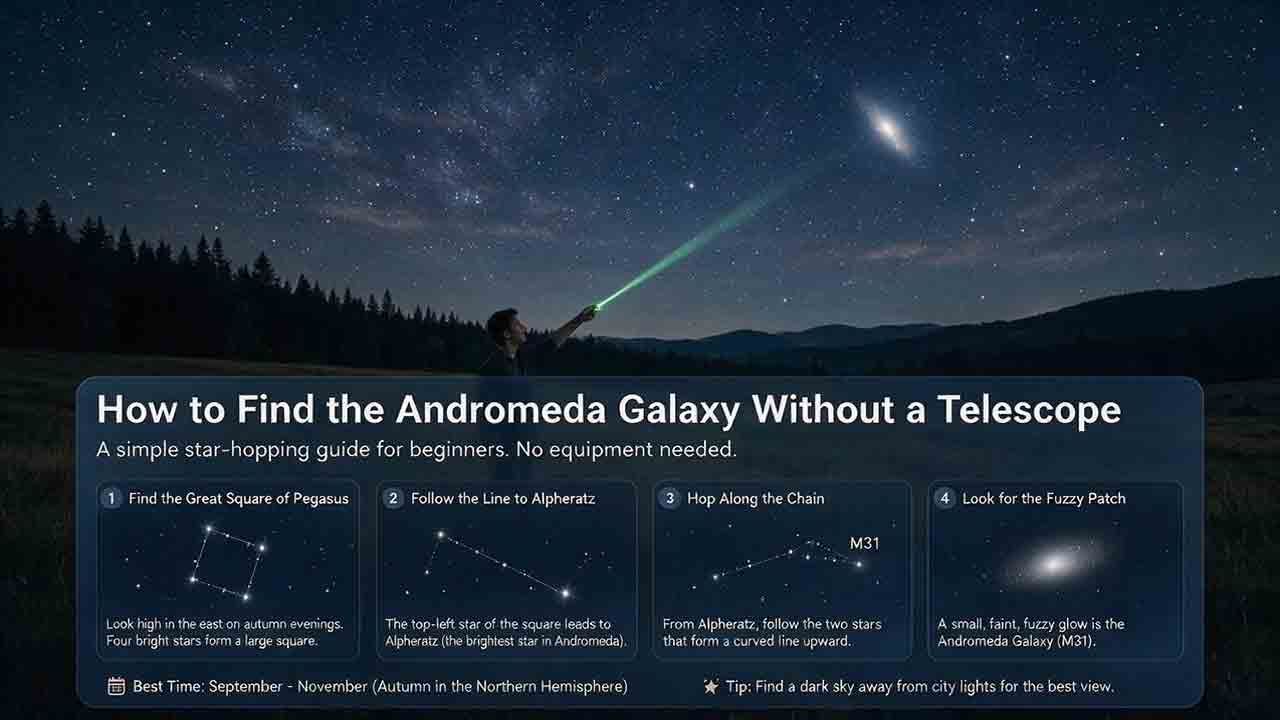
To find the Andromeda Galaxy without a telescope, locate the Great Square of Pegasus and identify Alpheratz, the corner star connected to Andromeda. Follow the star chain to Mirach, move about 4° to Mu Andromedae, then repeat nearly the same short hop. Under dark skies, M31 appears as a faint, borderless oval glow; binoculars can confirm the target.
Key Takeaways
- Follow the route Alpheratz → Mirach → Mu Andromedae → M31 instead of scanning randomly.
- Mu Andromedae lies about 4° from Mirach, slightly less than half a typical fist-width at arm’s length.
- From Mu Andromedae, continue nearly the same distance in the same direction to reach M31.
- Expect a dim gray haze rather than a bright star or a photograph-like spiral.
- This route is easiest from the Northern Hemisphere, although M31 is visible from many Southern Hemisphere locations.
This guide provides a route you can follow outdoors, a six-point readiness checklist, a gradual three-night practice method, and a reusable observation log.
When Is the Best Time to See the Andromeda Galaxy?
For most Northern Hemisphere observers, late summer through early winter provides convenient evening views of Andromeda. NASA’s Messier 31 guide identifies November as a particularly favorable observing month.
The galaxy’s compass direction is not fixed. M31 rises north of east, climbs higher, and moves westward as the night progresses, but its apparent position depends on your latitude, date, and local time.
This route is easiest in the Northern Hemisphere. From many Southern Hemisphere locations, M31 appears lower in the northern sky.
Your chances improve when:
- The air is clear and free from smoke, haze, or thin cloud.
- The Moon is dim, below the horizon, or far from the M31 region.
- M31 is well above the horizon.
- Nearby lights do not shine directly into your eyes.
- You have allowed time for your vision to adapt to darkness.
Seeing the four stars of the Great Square confirms that basic navigation is possible, but it does not guarantee that M31 will be visible to the naked eye. The galaxy has much lower surface brightness than the reference stars.
How Do You Find the Andromeda Galaxy Step by Step?
The most useful beginner route is:
Great Square of Pegasus → Alpheratz → Mirach → Mu Andromedae → M31
The International Astronomical Union’s Andromeda chart shows the official constellation boundaries and the relative positions of Alpheratz, Mirach, Mu Andromedae, and M31.
Step 1: Find the Great Square of Pegasus
Look for four moderately bright stars forming a large square or slightly uneven rectangle.
Depending on the date, time, and your location, the pattern may resemble an upright square, a tilted diamond, or a shape resting on one side. Do not depend on directions such as “upper left” or “northeast,” because the pattern rotates across the sky.
One corner is Alpheratz, also known as Alpha Andromedae. Identify it as the corner from which the main Andromeda star chain extends away from the Great Square.
Step 2: Follow the Andromeda Chain to Mirach
From Alpheratz, follow the brighter stars of Andromeda away from Pegasus. The route passes through Delta Andromedae before reaching Mirach, or Beta Andromedae.
Mirach is one of the constellation’s brightest stars and may appear slightly orange or warm-colored. It is approximately 14.5° from Alpheratz, or roughly one and a half fist-widths at arm’s length.
You do not need to memorize every intermediate star. Concentrate on recognizing the chain and reaching Mirach reliably.
Step 3: Move About 4° From Mirach to Mu Andromedae
From Mirach, turn away from the main Andromeda chain toward the M31 region.
Mu Andromedae lies about 4° from Mirach, slightly less than half of a typical 10° fist-width at arm’s length.
Mu Andromedae is fainter than Mirach. Under a bright suburban sky, it may be difficult to identify without binoculars.
If you use binoculars, check the field-of-view specification printed on the instrument or listed in its official documentation. Many common handheld binoculars can show Mirach and Mu Andromedae within one wide field or with only a small movement.
Step 4: Repeat Nearly the Same Short Hop
From Mu Andromedae, continue in almost the same direction for approximately the same distance.
This second short hop places you in the M31 region. The practical memory rule is:
Mirach to Mu Andromedae is one short hop. Repeat that hop from Mu Andromedae to reach M31.
Avoid making a large sweep after finding Mu Andromedae. Overshooting the galaxy is a common beginner mistake.
Step 5: Look for a Faint Oval Glow
At the end of the second hop, stop looking for another sharp star.
M31 usually appears as:
- A dim gray or whitish haze
- A small oval or elongated patch
- A glow without a clearly defined edge
- An object that stays fixed relative to nearby stars
Look slightly beside the suspected glow rather than staring directly at it. This method, called averted vision, can help reveal faint objects that disappear under direct vision.
Step 6: Confirm the Target With Binoculars
After identifying the correct naked-eye region, raise your binoculars without changing your body position.
M31 should become a more obvious elongated glow with a brighter central concentration. A sharp point is a star; M31 remains diffuse and does not focus into a point.
Binocular confirmation is useful even when the galaxy was first detected without equipment. It helps distinguish a genuine sighting from thin cloud, glare, or wishful interpretation.
How Far Apart Are the Main Landmarks?
The following angular separations were calculated as great-circle distances between the listed J2000 coordinates in the SIMBAD astronomical database and rounded for practical field use.
| Route segment | Calculated separation | Practical field estimate |
|---|---|---|
| Alpheratz to Mirach | Approximately 14.5° | About one and a half fists |
| Mirach to Mu Andromedae | Approximately 3.9° | About 4°, slightly less than half a fist |
| Mu Andromedae to M31 | Approximately 3.9° | Repeat the previous short hop |
| Mirach directly to M31 | Approximately 7.7° | Slightly less than one fist |
The precise values belong in the reference table because they describe the coordinate calculation. In the field, about 4° is a more realistic working estimate than attempting to measure tenths of a degree by hand.
According to the Sky & Telescope astronomy glossary, an index finger held at arm’s length spans approximately 1°, while a closed fist spans approximately 10°. These are rough personal measuring tools; hand size, arm length, and posture affect the result.
The Two-Equal-Hops Rule
The most useful field rule from the measurements is that the final two hops are nearly equal:
- Mirach to Mu Andromedae
- Mu Andromedae to M31
Remembering the geometry is more useful outdoors than memorizing a long list of coordinates.
What Does the Andromeda Galaxy Look Like Without a Telescope?
M31 does not resemble the colorful spiral photographs published by NASA or captured through long-exposure astrophotography.
NASA lists M31 at about 2.5 million light-years away and notes that it can be seen without optical equipment from a dark-sky site. Most naked-eye observers detect only its brighter central region.
| Viewing method | Realistic visual expectation |
|---|---|
| Naked eye | A dim, oval haze under suitable conditions |
| Binoculars | A brighter core with a broader diffuse glow |
| Small telescope | A bright core, extended haze, and possibly M32 |
| Larger telescope under dark skies | Greater extension and possible detection of M110 or subtle dust features |
A small telescope does not normally show prominent spiral arms like those in processed photographs. Under favorable conditions, M32 may appear as a compact companion. The fainter companion M110 generally requires darker skies and more observing experience.
High magnification is not always helpful. It narrows the field of view and may place only part of the large galaxy in the eyepiece.
Can a Stargazing App Help You Find Andromeda?
A sky-map app can confirm Pegasus, Alpheratz, Mirach, and the M31 region. Its purpose is navigation; it cannot guarantee that the galaxy will be visible through moonlight, haze, or light pollution.
Use an app efficiently:
- Set the correct location, date, and local time.
- Confirm the Great Square and Alpheratz.
- Lower the screen to its minimum practical brightness.
- Enable a red or night-display mode.
- Put the phone away before searching for M31.
- Reopen it only when the visible star pattern does not match the chart.
Open University guidance on dark adaptation explains that the retina may take up to approximately 20 minutes to become fully dark-adapted. NASA’s beginner guidance uses an estimate of around 30 minutes and warns that bright screens can temporarily reduce night vision.
A sky-map app helps with navigation. Smartphone photography is a separate task and depends heavily on the device, exposure controls, stability, software processing, and sky conditions.
Which Viewing Method Should You Choose?
| Your situation | Recommended method |
|---|---|
| Dark rural sky | Try the naked-eye route first |
| Suburban sky | Navigate by eye, then confirm with binoculars |
| Bright urban sky | Learn the route and use binoculars |
| You want to see companion galaxies | Use a telescope under darker skies |
| You are learning star hopping | Start without automated telescope pointing |
For most beginners, binoculars offer the best balance between light gathering and a wide field of view. They make M31 easier to confirm without removing the need to learn the surrounding stars.
Is Tonight Worth Trying? A Six-Point Checklist
Give the night one point for each statement that is true:
- The Moon is dim, below the horizon, or well away from M31.
- The sky is free from obvious cloud, smoke, and heavy haze.
- All four main stars of the Great Square are easy to identify.
- Mirach and at least one fainter reference star are visible.
- No streetlight, vehicle light, or bright window shines into your eyes.
- You have avoided bright white screens for at least 15–20 minutes.
How to Interpret the Checklist
| Total | Recommended approach |
|---|---|
| 5–6 | Try the naked-eye route before using binoculars |
| 3–4 | Locate Mirach and use binoculars for the final hops |
| 0–2 | Practice identifying the route and return under better conditions |
This checklist is an editorial planning tool, not a scientifically validated visibility scale. It does not guarantee a sighting. Eyesight, atmospheric transparency, altitude, local glare, and observing experience can change the result.
How Can Beginners Learn the Route Over Three Nights?
A first attempt can feel difficult because it combines constellation recognition, angular measurement, dark adaptation, and faint-object detection. Separating those skills makes the process more manageable.
Night 1: Learn the Great Square and Alpheratz
Your goals are to:
- Recognize the Great Square
- Identify the corner connected to Andromeda
- Confirm that the corner star is Alpheratz
Do not judge the session by whether you see M31.
Night 2: Learn Mirach and Mu Andromedae
Follow the Andromeda chain from Alpheratz to Mirach.
Then practice the shorter hop from Mirach to Mu Andromedae. Repeat the route until you can return to the same stars without checking a phone after every movement.
Night 3: Search for M31
Choose the clearest and darkest available night.
Allow your eyes to adapt, find Mirach, make the short hop to Mu Andromedae, and repeat nearly the same movement. Search the final area with averted vision, then confirm it with binoculars if available.
This approach turns a failed first sighting into useful progress rather than wasted time.
How Should You Plan Your First Observation?
Before You Leave
Check:
- Cloud, smoke, haze, and humidity forecasts
- The Moon’s phase and position
- Whether Andromeda will be above your horizon
- Whether the location is open and legally accessible
- Whether you can observe away from direct artificial glare
Bring warm clothing, a dim red light, a star chart or app, binoculars if available, and a chair for longer sessions.
Choose a safe location. Do not stop on an unsafe roadside, enter restricted property, or walk through unfamiliar terrain without adequate lighting.
At the Site
- Block direct glare before beginning dark adaptation.
- Identify the Great Square with the naked eye.
- Follow Alpheratz to Mirach.
- Make the short hop to Mu Andromedae.
- Repeat nearly the same hop toward M31.
- Use averted vision for several seconds.
- Confirm the field with binoculars.
- Record whether the result was seen, uncertain, or not seen.
Why Can’t You See the Andromeda Galaxy?
You Cannot Recognize the Great Square
Likely cause: The pattern is rotated differently from the chart, part of the sky is obscured, or the wrong four stars have been selected.
Best action: Use a sky app briefly to confirm the entire pattern and locate Alpheratz.
Mirach Is Visible but Mu Andromedae Is Not
Likely cause: Mu Andromedae is below your naked-eye contrast limit.
Best action: Center binoculars on Mirach and move slightly less than half a fist toward the M31 region.
You Reach the Correct Field but See Only Stars
Likely cause: M31 is below your current visibility threshold because of sky brightness, poor transparency, or incomplete dark adaptation.
Best action: Block direct glare, wait longer, and scan the field slowly with averted vision.
A Fuzzy Patch Changes Position or Shape
Likely cause: You are looking through thin cloud, smoke, or haze.
Best action: Watch the surrounding stars for several minutes. M31 remains fixed relative to them; cloud moves or changes shape.
The Binocular View Is Too Unsteady
Likely cause: Normal hand movement is blurring the faint glow.
Best action: Rest your elbows on a stable surface, lean against a wall, or sit in a supported position.
M31 Is Very Low Above the Horizon
Likely cause: The date, time, or latitude places it in a poor observing position.
Best action: Observe at another hour or during a season when Andromeda climbs higher.
What Common Mistakes Make M31 Harder to Find?
Looking for a Bright Point
M31 is an extended object whose light is spread across a broad area. Search for a weak change in background brightness, not a star-like point.
Moving Too Far Beyond Mu Andromedae
The final hop is approximately equal to the previous one. A large sweep can carry you well beyond the galaxy.
Depending on “Up,” “Left,” or “Northeast”
The apparent orientation changes during the night and differs by location. Use the sequence and spacing of the stars instead of fixed screen directions.
Starting With High Magnification
A narrow telescopic field makes navigation harder. Begin with the naked eye or low-power binoculars.
Staring Directly at the Suspected Galaxy
Direct vision may cause a faint object to disappear. Look slightly beside the glow and move your gaze gently around it.
Checking a Bright Screen Repeatedly
Use the phone to correct the route, not to accompany every step. Repeated white-light exposure works against dark adaptation.
What Might a First Suburban Attempt Look Like?
A beginner under suburban skies may locate Alpheratz and Mirach easily but struggle to see Mu Andromedae without binoculars. After finding Mu, repeating the same short hop can place the observer in the correct M31 field even when the galaxy is not immediately obvious.
Blocking a nearby porch light and using averted vision may reveal a stable central haze. If the naked-eye result remains uncertain but binoculars show an elongated glow in the expected position, the navigation attempt was successful.
This is an illustrative scenario based on common observing conditions, not a personal field report from the author.
Andromeda Observation Log
Use one copy of this table for each attempt.
| Observation item | Your record |
|---|---|
| Date and local time | |
| General location or latitude | |
| Moon phase and position | |
| Cloud, haze, smoke, or humidity | |
| Direct artificial glare | |
| Reference stars visible | |
| Method | Naked eye / binoculars / telescope |
| M31 result | Seen / uncertain / not seen |
| Appearance | |
| Most useful technique | |
| Change for next attempt |
Several records can reveal whether moonlight, local glare, low altitude, or poor atmospheric transparency is the main limitation at your observing site.
How Was This Guide Checked?
This guide is based on data review, chart comparison, coordinate calculations, and editorial usability checks rather than claimed field testing.
The review included:
- Checking M31’s distance and unaided-eye visibility against NASA material
- Comparing the route with the IAU Andromeda constellation chart
- Verifying the J2000 positions of Alpheratz, Mirach, Mu Andromedae, and M31 in SIMBAD
- Calculating great-circle angular distances between the listed coordinates
- Rounding the calculated values into practical field estimates
- Checking dark-adaptation guidance from NASA and the Open University
- Checking hand-based angular estimates and averted vision definitions
- Reviewing the article for changing sky directions and unrealistic telescope expectations
- Confirming that no personal field test or independent expert review is claimed
The calculated values are transparent reference estimates. They are not presented as measurements made by the author outdoors.
The Most Practical Route to Remember
Start with the Great Square and identify Alpheratz. Follow Andromeda’s main star chain to Mirach, make one short hop to Mu Andromedae, and repeat approximately the same hop to reach M31.
Try the naked-eye view first under dark conditions, then use binoculars to confirm the diffuse glow. When the galaxy remains hidden, practice the route rather than forcing a sighting under unsuitable skies.
Frequently Asked Questions
Can Cassiopeia Help You Find the Andromeda Galaxy?
Yes. The W-shaped Cassiopeia constellation can guide you toward the general Andromeda region, and NASA’s Night Sky Network guide presents Cassiopeia and the Great Square as useful landmarks.
The Alpheratz–Mirach–Mu Andromedae route is usually more precise for the final approach.
Is M31 Visible From the Southern Hemisphere?
M31 is visible from many low- and middle-latitude Southern Hemisphere locations, but it appears in the northern sky and may remain low above the horizon.
Its declination is approximately +41°. Using an ideal geometric horizon, this means it does not rise from locations south of roughly 49°S. Even north of that limit, atmospheric extinction and haze can make a low target difficult to see. The star pattern may also look rotated compared with a north-up chart.
Can You See M31 From a City?
Sometimes, especially with binoculars, but results vary. Bright skyglow lowers the contrast between the galaxy and the background sky.
A darker observing position, shielding your eyes from direct lights, and choosing a clear moonless night can improve the result. Seeing the Great Square alone does not prove that the sky is dark enough for naked-eye M31.
Can a Smartphone Photograph M31 Without a Telescope?
Some phones may record M31’s brighter center when mounted securely and used with suitable long-exposure controls. Results depend on the phone, software, exposure duration, stability, image processing, and sky brightness.
A handheld snapshot should not be treated as a reliable substitute for binocular observation.
Will a Small Telescope Show Andromeda’s Spiral Arms?
Usually not as clear spiral arms. A small telescope commonly shows a bright central core and diffuse surrounding light. M32 may be visible, while M110 and subtle structure require better conditions and more experience.
The colorful, highly structured images seen online are normally produced through long exposures and image processing.
What Should You Do If Mu Andromedae Is Not Visible?
Use binoculars to locate it from Mirach. Move about 4°, slightly less than half a fist at arm’s length, along the route toward M31.
Once Mu Andromedae is identified, repeat approximately the same short movement to reach the galaxy’s position.
Sources
More from Constellations & Star Hopping
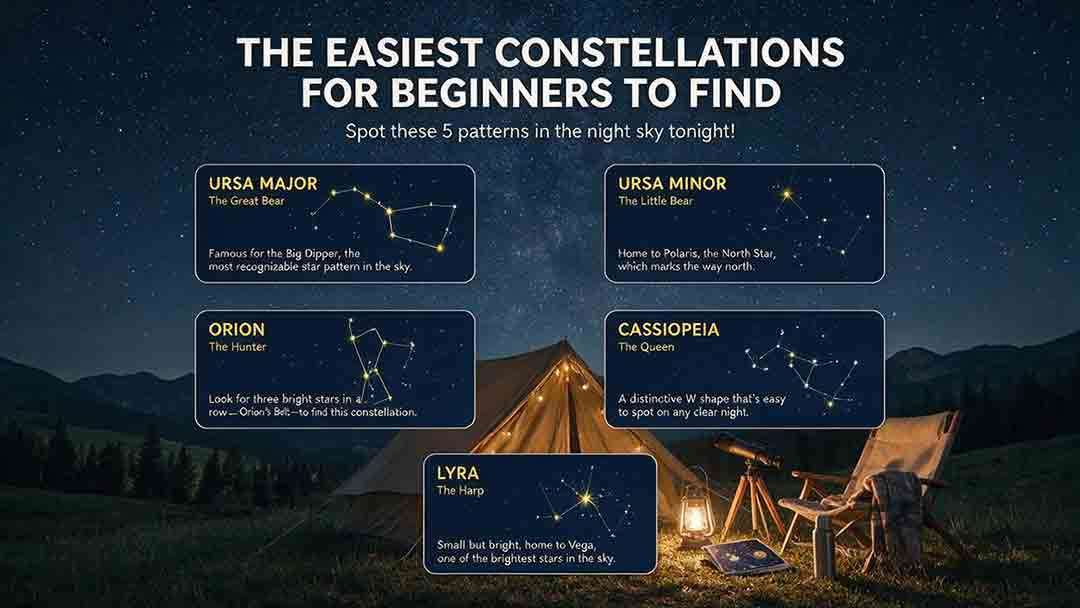
The Easiest Constellations for Beginners to Find
This beginner-friendly guide explains how to find Orion, Ursa Major through the Big Dipper, Cassiopeia, Cygnus, and Scorpius using clear naked-eye observing steps. It compares each pattern through an original Beginner Visibility Score and shows readers how to choose a first target based on season, latitude, light pollution, moonlight, and horizon visibility. The guide also clarifies the difference between constellations and asterisms, explains how the Big Dipper can point toward Polaris, and provides dedicated recommendations for Southern Hemisphere observers, including Crux. Practical tools include the Anchor-Pattern Method, the Three-Check Rule, a 10-minute observing session, city-sky guidance, troubleshooting advice, an equipment comparison, and a safety checklist. Authoritative references from the International Astronomical Union, NASA, NSF NOIRLab, and the European Southern Observatory support the key astronomical facts.
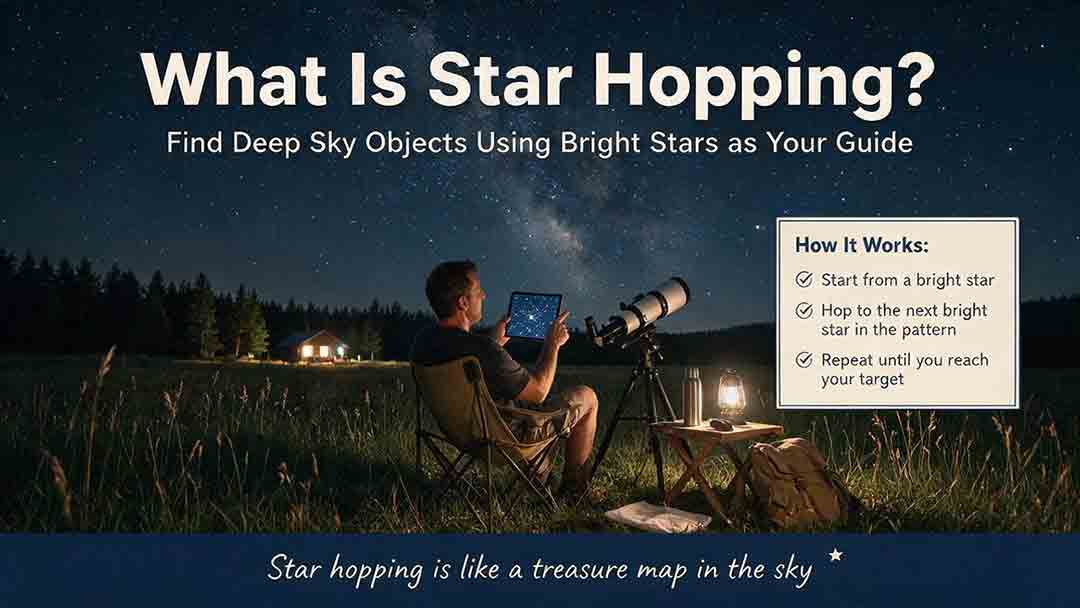
What Is Star Hopping and How Do You Do It?
Star hopping is a practical way to navigate the night sky by moving from a bright, recognizable star to a fainter target through a sequence of visible star patterns. This guide explains how beginners can plan a reliable route, align a finder, match a star chart to a telescope’s field of view, and recognize rotated or mirror-reversed images. It introduces the Anchor–Path–Field–Confirm method, provides a step-by-step observing process, and shows how field-of-view estimates can help determine a practical chart scale. A worked example demonstrates how to locate Messier 13 using the Keystone of Hercules, while the troubleshooting table addresses common problems such as finder misalignment, excessive magnification, incorrect chart orientation, and targets that remain invisible despite correct pointing. The included field checklist gives binocular and telescope users a repeatable method for planning and completing future star hops.
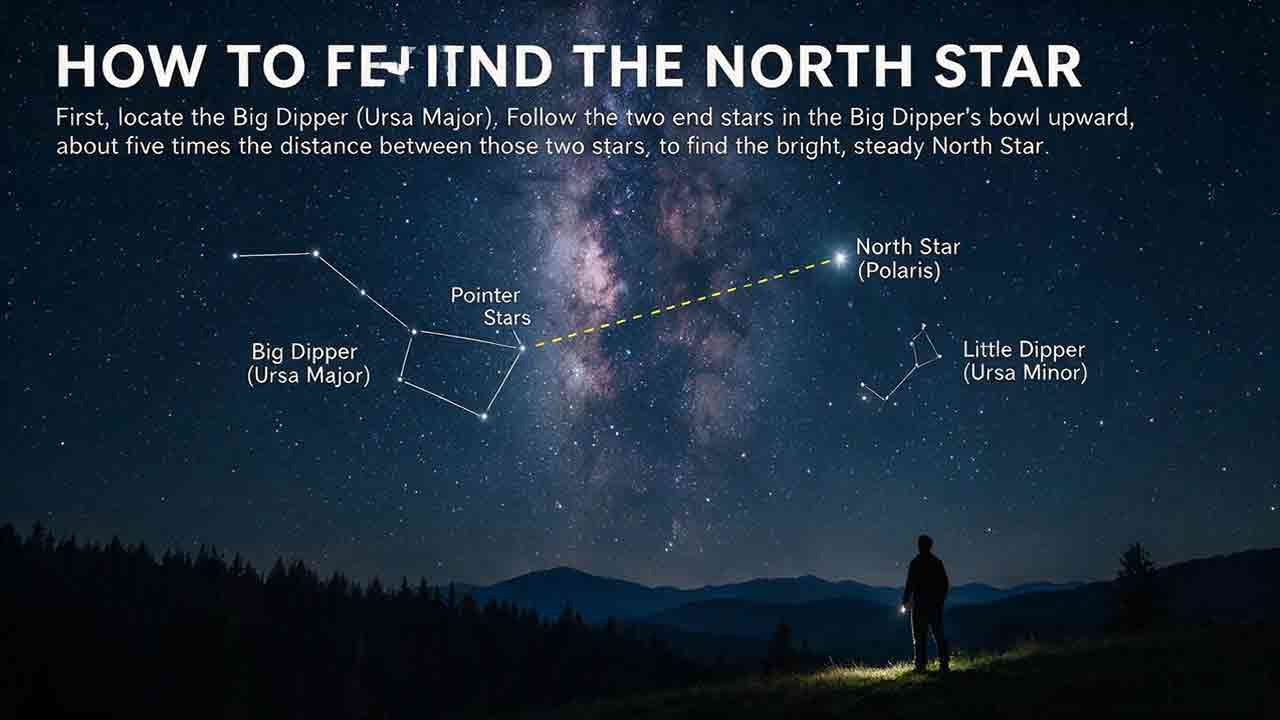
How to Find the North Star
Finding the North Star becomes straightforward once you know how to use the Big Dipper’s two pointer stars, Merak and Dubhe. This practical guide walks beginners through the complete process of locating Polaris, confirming it by position and latitude, and avoiding common mistakes such as choosing the brightest star or following the pointer line in the wrong direction. It also explains why Polaris appears nearly stationary, how its altitude relates approximately to an observer’s northern latitude, and why the full Little Dipper may be difficult to see under city skies. Readers will find troubleshooting advice for haze, light pollution, blocked horizons, misleading astronomy apps, and compass differences caused by magnetic declination. The article also includes a quick confirmation checklist, viewing-condition comparisons, an observation log, and a seven-step field routine. Clear safety guidance explains that Polaris is useful for approximate orientation but should not replace proper navigation tools.
Explore More Topics
How to Stay Warm and Comfortable During Winter Stargazing
Winter stargazing requires more preparation than wearing one heavy coat because observers often remain nearly motionless for long periods. This guide explains how to check temperature, wind chill, road conditions, snow, and shelter before leaving; build a moisture-managing base, insulating middle, and wind-resistant outer layer; and protect hands, feet, head, face, chair, and ground contact. Readers will learn how to combine liner gloves with mittens, avoid sweat, plan warm-up breaks, use heated clothing safely, manage food and hydration, protect batteries, and prevent condensation when cold equipment returns indoors. The article also includes the WARMER planning framework, clothing and glove comparisons, a three-hour worked example, cold-stress warning signs, troubleshooting guidance, departure rules, FAQs, and a complete winter stargazing checklist.
Red Flashlights for Stargazing: Why Astronomers Use Them
Astronomers use dim red flashlights because dark-adapted rod vision is less sensitive to long-wavelength red light than to much of the visible spectrum. A controlled red beam can illuminate charts, eyepieces, cables, and walking paths while causing less disruption than a typical white flashlight. This guide explains how rods, cones, rhodopsin, wavelength, brightness, exposure time, and beam direction shape the result. Readers will learn why red light is not harmless, how to compare handheld lights and headlamps, which product features prevent accidental white-light activation, how to configure a phone screen, and when safety requires a white emergency light. The article also includes the RED-SAFE buying framework, a task-lighting table, a worked observing example, DIY filter guidance, star-party etiquette, troubleshooting advice, FAQs, and complete purchase and field-use checklists.
Stargazing While Camping: A Practical Planning Guide
Camping can provide long, convenient access to dark skies, but a successful astronomy trip requires more than choosing the darkest location on a map. This guide explains how to combine campground rules, weather, Moon timing, food storage, wildlife protection, quiet hours, power, dew control, and telescope setup into one workable plan. It introduces the original CAMP framework—Confirm access, Align conditions, Map functional zones, and Prepare fallbacks—plus a three-zone campsite layout separating sleeping, service, and observing areas. Readers can compare developed, walk-in, backcountry, dispersed, and astronomy-focused campgrounds; build a night schedule from daylight arrival through morning pack-up; and use practical decision tables for Moonlight, cloud, wind, dew, neighboring lights, and campfire impacts. The article also includes a hypothetical two-night family plan, a go/modify/cancel decision tree, troubleshooting guidance, and a complete campsite checklist grounded in NASA, National Park Service, and National Weather Service resources.