What Can You See in the Night Sky Without a Telescope?

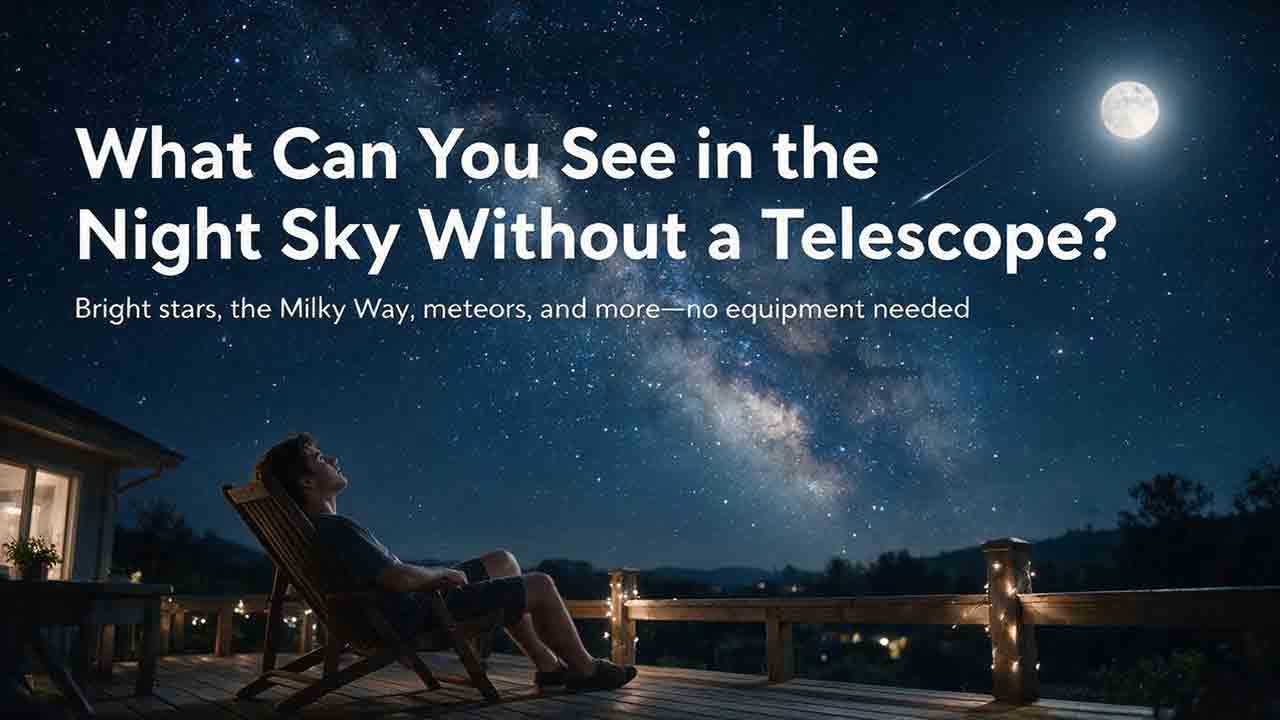
Without a telescope, you can see the Moon, Mercury, Venus, Mars, Jupiter, Saturn, bright stars, constellations, several star clusters, meteors, and artificial satellites. Under darker skies, you may also see the Milky Way, the Andromeda Galaxy, the Orion Nebula, and the Magellanic Clouds. Auroras, eclipses, bright comets, and zodiacal light depend on location and timing.
Key Takeaways
- The Moon, bright planets, major stars, and several constellations are visible from many cities.
- Mercury, Venus, Mars, Jupiter, and Saturn are the five planets commonly visible to unaided eyes.
- The Milky Way and Andromeda Galaxy require much darker conditions than the Moon or planets.
- Meteors and satellite passes are often better viewed without magnification because they cross large areas of sky.
- Knowing when and where to look usually matters more than buying equipment.
This guide separates dependable beginner targets from objects that are only technically visible under exceptional conditions. It also shows what each target really looks like, how to choose an observing location, and how to plan a useful first session.
What Counts as Naked-Eye Stargazing?
Naked-eye or unaided-eye stargazing means observing without binoculars, a telescope, a camera, or an electronic image-intensifying device.
Ordinary prescription glasses and contact lenses still count as unaided viewing. They correct eyesight but do not magnify a celestial object.
A phone can help identify constellations or check rise and set times. However, a phone’s night-mode photograph is not an accurate record of what the eye saw because the camera may combine several exposures and reveal much fainter light.
NASA notes that no special equipment is required to begin skywatching. Human eyes are particularly well suited to broad sights such as constellations, planetary groupings, the Milky Way, and meteor showers. See NASA’s Skywatching FAQ for an overview of beginner observing.
Objects Visible Without a Telescope
Unaided eyes can detect objects ranging from nearby artificial satellites to a galaxy approximately 2.5 million light-years away.
Visibility is not determined by brightness alone. An object’s altitude, apparent size, contrast, atmospheric conditions, moonlight, local lighting, and the observer’s experience can all change the result.
The following table distinguishes routine targets from advanced edge cases.
| Object or phenomenon | What it looks like unaided | Reliability | Best conditions |
|---|---|---|---|
| Moon | Bright disk with changing phases and broad surface markings | Reliable when above the horizon | Almost any clear sky |
| Venus | Exceptionally bright white point | Reliable when favorably positioned | Western evening or eastern morning sky |
| Jupiter | Very bright cream-white point | Reliable when favorably positioned | Clear sky with an open view |
| Mars | Orange or reddish point | Usually visible when well placed | Brightest around favorable oppositions |
| Saturn | Steady pale-yellow point | Usually visible when well placed | When sufficiently high above the horizon |
| Mercury | Bright star-like point low in twilight | Timing-dependent | Clear horizon near greatest elongation |
| Bright stars | Sharp points, sometimes with subtle colors | Reliable | Any reasonably clear night |
| Major constellations | Recognizable patterns formed by bright stars | Season- and location-dependent | Limited glare and an open view |
| Pleiades | Small, compact group of stars | Usually visible | Suburban or darker sky |
| Hyades | Large V-shaped star group | Usually visible | Suburban or darker sky |
| Orion Nebula | Slightly fuzzy point in Orion’s Sword | Dark-sky dependent | Dark suburban or rural sky |
| Milky Way | Broad, uneven band of pale light | Strongly dark-sky dependent | Rural, moonless, transparent sky |
| Andromeda Galaxy | Faint oval or diffuse smudge | Dark-sky dependent | Dark suburban or rural sky |
| Magellanic Clouds | Detached, cloud-like patches | Latitude- and darkness-dependent | Southern skies away from artificial light |
| Meteors | Brief streaks of light | Event- and chance-dependent | Broad open sky |
| International Space Station | Bright point moving smoothly | Pass-dependent | Predicted visible pass |
| Other satellites | Moving points that generally do not blink regularly | Timing-dependent | After dusk or before dawn |
| Aurora | Glow, arcs, rays, or curtains | Latitude- and activity-dependent | Clear sky during elevated geomagnetic activity |
| Bright comet | Diffuse object, sometimes with a tail | Event-dependent | A comet bright enough for unaided viewing |
| Zodiacal light | Faint triangular glow near the horizon | Advanced dark-sky target | Dark site during favorable seasonal geometry |
| Uranus | Extremely faint star-like point | Advanced challenge | Exceptional darkness and precise identification |
| Triangulum Galaxy | Very faint diffuse patch | Exceptional challenge | Pristine sky and experienced vision |
| Neptune | Not realistically visible unaided | Optical aid required | Binoculars or telescope |
| Saturn’s rings | Not visible unaided | Optical aid required | Telescope |
| Jupiter’s major moons | Not reliably separable unaided | Optical aid required | Binoculars or telescope |
“Visible” should not be confused with “easy.” Uranus and the Triangulum Galaxy may fall within the theoretical limits of human vision, but they are not sensible first-night targets.
What the Night Sky Actually Looks Like
The real night sky is usually dimmer, less colorful, and less detailed than astronomical photographs.
A camera can collect light for many seconds or minutes. Image processing can then increase contrast and reveal colors that were too faint for the eye at the observing site.
A realistic unaided view is more restrained:
- The Milky Way normally appears pale gray, silver, or milky rather than vividly colored.
- The Andromeda Galaxy looks like a faint smudge, not a visible spiral.
- The Orion Nebula appears slightly fuzzy rather than bright pink or green.
- A weak aurora may look gray even when a phone records green.
- Planets remain points of light rather than detailed worlds.
- Star colors are usually subtle unless the star is bright.
This difference is important because beginners often search for the photographic version of an object and overlook the real one.
The better question is not, “Does it look like the picture?” It is, “Is there a change in brightness, shape, texture, or position where the object should be?”
The Naked-Eye Visibility Ladder
The Naked-Eye Visibility Ladder is an editorial planning tool created for this guide. It is not an official scientific scale and does not replace a measured sky-brightness rating.
Its purpose is to help readers set realistic expectations before going outside.
Level 1: Bright Urban Sky
A bright urban sky may show fewer stars, but it still offers worthwhile observing.
Good targets include:
- The Moon
- Venus and Jupiter
- Mars or Saturn when favorably positioned
- Sirius, Vega, Arcturus, and other bright stars
- Parts of Orion, Cassiopeia, and the Big Dipper
- Bright meteors
- The International Space Station
- Lunar eclipses
A practical urban improvement is to stand where a wall, tree, or building blocks a nearby lamp. Reducing direct glare can help even when the wider sky remains bright.
Level 2: Suburban Sky
A darker suburban site may reveal complete constellation patterns and several bright clusters.
Possible additions include:
- The Pleiades
- The Hyades
- The Beehive Cluster
- Orion’s Sword
- A faint impression of the Orion Nebula
- More meteors and satellites
- The Andromeda Galaxy under favorable conditions
Andromeda is not dependable under moderate or strong light pollution. Its central region may occasionally be detected from a darker suburban location, but beginners have a much better chance from a rural site.
Level 3: Rural Dark Sky
A rural location away from major light domes can reveal the night sky as a connected landscape.
Likely targets include:
- The Milky Way
- Dark lanes crossing brighter Milky Way regions
- The Andromeda Galaxy
- Numerous open star clusters
- Fainter meteors
- Zodiacal light during a favorable season
- The Magellanic Clouds from suitable southern latitudes
At this level, familiar constellations can initially become harder to recognize because many additional stars are visible.
Level 4: Exceptional Dark Sky
Under an exceptionally dark and transparent sky, a person with good eyesight may see a few thousand stars across the visible sky at one time.
The number varies substantially with eyesight, latitude, atmospheric clarity, altitude, season, moonlight, and horizon obstructions. It is not a fixed total that every observer will see.
NSF NOIRLab’s Globe at Night findings explain how artificial skyglow removes progressively fainter stars from human sight.
What Can You See on the Moon?
Unaided eyes can follow the Moon’s phases, see broad dark plains and bright highlands, notice earthshine, and watch a lunar eclipse.
The large dark regions often associated with the “face” of the Moon are mainly lunar maria. These are extensive plains formed by ancient volcanic activity.
The brighter terrain consists largely of older, heavily cratered highlands. Normal unaided vision cannot clearly resolve most individual craters, although broad ray patterns and brightness differences may be noticeable.
Moon Phases
The Moon completes a phase cycle approximately every 29.5 days, according to NASA’s Moon Phases guide.
The eight commonly named phases are:
- New Moon
- Waxing crescent
- First quarter
- Waxing gibbous
- Full Moon
- Waning gibbous
- Third quarter
- Waning crescent
A full Moon is brightest, but it is not always the best phase for noticing surface relief.
During crescent, quarter, and gibbous phases, shadows near the boundary between lunar day and night make the terrain appear more textured. This boundary is called the terminator.
Earthshine
A thin crescent Moon may show a faint glow across the otherwise dark part of its disk.
This effect is called earthshine. Sunlight reflects from Earth to the Moon and then back toward the observer.
Earthshine is usually easiest to notice around a waxing crescent after sunset or a waning crescent before sunrise.
Lunar Eclipses
A lunar eclipse occurs when the Moon passes through Earth’s shadow.
During a total lunar eclipse, the Moon can become coppery, orange, or red because sunlight passing through Earth’s atmosphere is filtered and bent toward the lunar surface.
Lunar eclipses are safe to watch directly with unaided eyes.
Solar safety warning: Never look directly at the Sun or a solar eclipse without proper solar-viewing protection. Ordinary sunglasses, clouds, exposed film, smoked glass, compact discs, photographic neutral-density filters, and homemade filters are not safe substitutes.
Cameras, binoculars, and telescopes require a filter specifically designed for solar observation and secured over the front, Sun-facing end of the optics. Do not use an eyepiece solar filter. Do not look through magnifying optics while wearing ordinary eclipse glasses. Review NASA’s Eclipse Viewing Safety guidance before any solar observation.
Which Planets Can You See Without a Telescope?
Mercury, Venus, Mars, Jupiter, and Saturn are the five planets commonly visible to unaided eyes.
They look like star-like points because normal human vision cannot resolve their disks. Their brightness and position change as Earth and the planets move around the Sun.
| Planet | Naked-eye appearance | When it is easiest to see | Main limitation |
|---|---|---|---|
| Mercury | Bright point low in twilight | Near greatest elongation after sunset or before sunrise | Low altitude and short observing window |
| Venus | Brilliant white point | Western evening or eastern morning sky | Never appears far from the Sun |
| Mars | Orange or reddish point | When well placed; brightest around favorable oppositions | Brightness varies greatly |
| Jupiter | Very bright cream-white point | When high in the evening or morning sky | Atmospheric details and moons need magnification |
| Saturn | Steady pale-yellow point | When well above the horizon | Rings need magnification |
NASA’s Skywatching FAQ explains why Mercury and Venus remain near sunrise or sunset while Mars, Jupiter, and Saturn can appear much farther from the Sun in the night sky.
Mercury
Mercury is not always faint. Its main problem is that it never appears far from the Sun.
The best opportunities usually occur near greatest elongation, when Mercury reaches its widest apparent separation from the Sun. Even then, haze, buildings, hills, and bright twilight can hide it.
Choose a clear and unobstructed horizon. Confirm its direction and observing time before going outside.
Venus
Venus is usually the easiest planet to recognize.
It can become brighter than every star and is often mistaken for an aircraft or an unusual artificial light. Venus appears either in the western sky after sunset or in the eastern sky before sunrise.
Venus does not remain visible throughout the entire night because its orbit lies closer to the Sun than Earth’s orbit.
Mars
Mars often has a noticeable orange or reddish tone.
It remains visible to unaided eyes during many parts of its orbit, but its brightness varies substantially. Mars is generally brightest around favorable oppositions, when it is well positioned in the night sky and comparatively close to Earth.
Jupiter
Jupiter is usually one of the brightest points in the night sky.
It appears as a single cream-white point to unaided eyes. Its cloud bands, Great Red Spot, and four large Galilean moons require optical assistance.
Although Jupiter’s major moons are individually bright enough in principle, the planet’s glare and their close apparent separation make them unreliable unaided-eye targets.
Saturn
Saturn usually appears as a steady pale-yellow or cream-colored point.
Its rings cannot be separated from the planet with normal unaided vision. A small telescope can reveal the ring system, but binoculars generally show Saturn only as a bright point or slightly elongated object.
Uranus and Neptune
Uranus can reach a brightness close to the theoretical unaided-eye limit.
In practice, identifying it requires an exceptionally dark sky, an accurate chart, good eyesight, and enough experience to separate it from nearby faint stars. It should be treated as an advanced challenge rather than a routine naked-eye planet.
Neptune is too faint for unaided observation and requires optical assistance.
Daytime Venus Is Not a Beginner Target
Venus can technically be visible during daylight when its position is known precisely.
For beginners, the recommended option is not to attempt daytime Venus observing. Observe it after sunset or before sunrise instead.
Do not scan the daytime sky with binoculars, a telescope, or a camera. Accidentally pointing magnifying optics toward the Sun can cause immediate and permanent eye injury.
Stars, Constellations, and Star Colors
Bright stars and large star patterns are among the most dependable naked-eye targets.
They also provide reference points for finding planets, star clusters, galaxies, and directions.
Useful beginner patterns include:
- Orion, recognized by three stars in a straight belt
- The Big Dipper, an asterism within Ursa Major
- Cassiopeia, commonly shaped like a W or M
- The Summer Triangle, formed by Vega, Deneb, and Altair
- Scorpius, containing the reddish star Antares
- Crux, the Southern Cross
- The Southern Triangle, visible from southern locations
A constellation is one of the 88 officially defined regions of the celestial sphere.
An asterism is a recognizable star pattern that is not itself an official constellation. The Big Dipper and Summer Triangle are well-known asterisms.
Readers learning to match maps with the real sky can use How to Read a Star Chart.
Why Constellations Change With the Seasons
Earth’s nighttime side faces different directions in space as Earth travels around the Sun.
A constellation prominent on winter evenings may be absent from the evening sky several months later. It has not disappeared; it may be above the horizon during daylight or below the horizon at that hour.
The exact seasonal pattern also depends on the observer’s latitude.
Why Stars Twinkle More Than Planets
Stars appear as extremely narrow points of light.
Moving air in Earth’s atmosphere bends that light unevenly, producing rapid changes in brightness and color called scintillation.
Planets usually look steadier because their tiny apparent disks cover a slightly larger area. Atmospheric disturbances affecting different parts of the disk partly average together.
A planet can still shimmer strongly when it is low near the horizon, where its light passes through more atmosphere.
Can You See Star Colors?
Yes, but the colors are usually subtle.
Examples include:
- Betelgeuse and Antares: orange or reddish
- Arcturus: warm orange
- Rigel and Spica: blue-white
- Vega: white with a cool appearance
- Sirius: white, but sometimes flashing several colors near the horizon
Color becomes harder to detect in faint objects because human low-light vision is more sensitive to brightness than color.
Using the Big Dipper to Find North
In much of the Northern Hemisphere, the two stars at the outer edge of the Big Dipper’s bowl point toward Polaris.
Polaris lies near the north celestial pole and therefore changes position much less than most other stars during the night.
A complete step-by-step method is available in How to Find the North Star.
Star Clusters and Nebulae Visible to Unaided Eyes
Several star clusters and at least one famous nebula are visible without a telescope.
Clusters may look like groups of separate stars or hazy concentrations. Nebulae usually appear much less colorful and detailed than photographs suggest.
The Pleiades
The Pleiades, also called Messier 45 or the Seven Sisters, is a compact open cluster in Taurus.
It resembles a tiny dipper or a small group of tightly packed stars. Different observers count different numbers of visible stars depending on eyesight, glare, sky darkness, and experience.
NASA describes the brightest Pleiades stars as visible to unaided eyes. See NASA’s Hyades and Pleiades observing guide.
The Hyades
The Hyades forms a broad V-shaped pattern in Taurus.
Bright orange Aldebaran appears along the same line of sight but is not physically part of the cluster.
Because the Hyades covers a wide area of sky, it is especially well suited to naked-eye observing. Orion’s Belt can help guide the eye toward both the Hyades and Pleiades.
The Beehive Cluster
The Beehive Cluster, or Messier 44, lies in the constellation Cancer.
From a dark location, it may first appear as a misty patch. Under better conditions, individual stars begin to separate.
It is more difficult than the Pleiades because Cancer does not contain many bright guide stars.
The Orion Nebula
The Orion Nebula, Messier 42, lies in Orion’s Sword below the three belt stars.
Under a reasonably dark sky, its central region appears as a slightly fuzzy or swollen point. It does not show the vivid colors found in processed space images.
NASA confirms that the Orion Nebula can be spotted with unaided eyes from a dark-sky location.
The Milky Way and Other Galaxies
Can You See the Milky Way Without a Telescope?
Yes, but the Milky Way requires a dark, transparent sky with little competing moonlight.
It appears as a broad and irregular band of pale light. Dark lanes may divide brighter areas, especially near the dense central region.
The solar system lies within the Milky Way’s disk. When observers look along that disk, they see the combined glow of vast numbers of distant stars mixed with dark clouds of interstellar dust.
NASA’s guide to observing the Great Rift emphasizes that photographs usually show much more color and structure than unaided eyes.
Conditions That Reveal the Milky Way
Your chances improve when:
- The Moon is below the horizon or in a thin phase.
- The sky is free from smoke, cloud, and heavy haze.
- You are away from a major city’s light dome.
- The Milky Way is high rather than close to the horizon.
- Your eyes have adjusted to darkness.
- Nearby lamps and phone screens are blocked or dimmed.
A full Moon can hide much of the Milky Way even from an otherwise excellent rural location.
Where to Look
In the Northern Hemisphere, the rich region toward Sagittarius and Scorpius is prominent on suitable summer evenings. The Milky Way also passes through Cygnus, Cassiopeia, Perseus, and other constellations.
Southern Hemisphere observers can see the bright central Milky Way rise much higher. Dark features such as the Coalsack may also be prominent.
Latitude and season matter. A famous target may be below your horizon or visible only during a different part of the year.
The Andromeda Galaxy
The Andromeda Galaxy is the most accessible external galaxy for many Northern Hemisphere observers.
Also called Messier 31 or M31, Andromeda lies approximately 2.5 million light-years away. NASA’s Andromeda observing guide describes it as a faint, fuzzy naked-eye object.
To unaided eyes, the visible part is mainly the bright central region. Spiral arms are not apparent.
To find it:
- Choose a clear night with little moonlight.
- Observe from a rural site or dark suburban edge.
- Confirm that Andromeda is well above the horizon.
- Use the Great Square of Pegasus or Cassiopeia as a guide.
- Look for a diffuse patch rather than a sharp point.
- Shift your gaze slightly beside its expected position.
Andromeda remains a dark-sky-dependent target for most beginners.
The Magellanic Clouds
The Large and Small Magellanic Clouds are dwarf galaxies associated with the Milky Way.
They appear as detached cloud-like patches in southern skies. They are not visible from most mid- and high-northern latitudes, regardless of how dark the observing site is.
The Triangulum Galaxy
The Triangulum Galaxy, Messier 33, sometimes appears on lists of naked-eye objects.
It has low surface brightness and should be treated as an exceptional challenge. A credible unaided detection generally requires pristine darkness, excellent transparency, accurate positioning, experienced vision, and prior knowledge of its appearance.
It is not a practical first galaxy for a beginner.
Identifying Meteors, Satellites, and Aircraft
Meteors, satellites, and aircraft can be distinguished by their duration, path, blinking pattern, and sound.
Meteors
A meteor is the flash produced when a small natural particle enters Earth’s atmosphere at high speed.
Meteors may appear on any clear night. During an annual meteor shower, Earth passes through a stream of debris associated with a comet or asteroid.
Unaided eyes are ideal for meteor watching because meteors can appear across a wide area of sky.
For a meteor shower:
- Choose the darkest safe site available.
- Use a reclining chair or blanket.
- Keep a broad view of the sky.
- Do not stare only at the radiant.
- Allow your eyes to adapt.
- Expect uneven activity rather than a constant stream.
Artificial Satellites
Many satellites appear as steady points moving smoothly across the stars.
They are often easiest to see after evening twilight or before morning twilight. At those times, the observer may be in darkness while the satellite remains illuminated by sunlight high above Earth.
A satellite may brighten, fade, enter Earth’s shadow, or appear partway across the sky when it moves into sunlight.
The International Space Station
The International Space Station can become one of the brightest moving objects in the sky.
It resembles a bright star or aircraft moving steadily without regular blinking. A visible pass may last several minutes.
NASA’s Spot the Station service provides location-based viewing opportunities and pass information.
Satellite, Aircraft, or Meteor?
| Feature | Satellite or ISS | Aircraft | Meteor |
|---|---|---|---|
| Duration | Several seconds to several minutes | Usually several minutes | Usually less than a few seconds |
| Path | Smooth and generally straight | May turn or follow an airport route | Brief streak |
| Lights | Usually steady; may fade | Often regularly blinking or multicolored | Continuous flash or streak |
| Sound | Silent | May become audible | Usually silent |
| End of visibility | Fades, enters shadow, or reaches the horizon | Moves away or becomes obstructed | Disappears abruptly |
Rare and Conditional Naked-Eye Sights
Some of the most memorable sky phenomena require no equipment, but they cannot be expected on an ordinary night.
Auroras
Auroras form when charged particles associated with solar activity interact with Earth’s magnetic environment and upper atmosphere.
They are most common at high northern and southern latitudes. Strong geomagnetic storms can extend visible auroras farther toward the equator.
A weak aurora may appear gray or nearly colorless even when a phone records green. Stronger displays may produce visible arcs, rays, curtains, and movement.
Use NOAA’s Aurora 30-Minute Forecast for near-term activity and the Aurora Viewline for broader geographic guidance.
Forecast maps indicate possibilities, not guarantees. Cloud, moonlight, local lighting, terrain, and latitude still determine what can actually be seen.
Bright Comets
Most comets require binoculars or a telescope.
Occasionally, a comet becomes bright enough for unaided viewing. It may resemble a diffuse star, a hazy coma, or a faint object with a visible tail.
Comet brightness forecasts are uncertain. A comet can brighten less than expected, fade, fragment, or remain too close to twilight.
Avoid treating early claims of a “spectacular” comet as a guaranteed result.
Zodiacal Light
Zodiacal light is sunlight scattered by dust distributed through the inner solar system.
It appears as a faint triangular or cone-shaped glow extending upward from the horizon along the ecliptic. It is sometimes called a false dawn.
NASA’s guide to aurora, noctilucent clouds, and zodiacal light explains the seasonal and geographic differences in visibility.
Zodiacal light requires:
- A genuinely dark location
- A clear horizon
- Little or no moonlight
- Good atmospheric transparency
- Favorable seasonal timing
Noctilucent Clouds
Noctilucent clouds are very high clouds that remain sunlit after the lower atmosphere has entered darkness.
They can appear as thin, silver, white, or electric-blue structures during twilight. They are most often reported during local summer from middle to high latitudes, although visibility varies by year and location.
Noctilucent clouds behave like delicate cloud patterns rather than auroral curtains. NASA provides additional background in Night Lights: Aurora, Noctilucent Clouds, and the Zodiacal Light.
Eclipses
Lunar eclipses are safe to observe directly.
Solar eclipses require proper eye protection whenever any part of the Sun’s bright surface remains visible. Clouds, haze, sunglasses, or looking at a camera screen do not automatically make solar viewing safe.
Do not attempt to construct a solar filter from household materials.
How to See More With Only Your Eyes
The greatest improvements come from choosing an appropriate target, reducing glare, and allowing your eyes to adapt.
1. Confirm That the Object Is Available
Before going outside, check whether:
- The object is above your horizon.
- It is visible from your latitude.
- It is sufficiently separated from the Sun.
- It is high enough to clear buildings or trees.
- The season is appropriate.
- A predicted event occurs at your local time.
A planet can be described as “visible this month” yet still be below the horizon at the hour you look.
2. Check the Moon and Observing Time
The Moon is not always an obstacle.
A bright Moon is ideal when lunar observing is the goal. It is a disadvantage when looking for the Milky Way, galaxies, zodiacal light, or faint meteors.
Check both the phase and whether the Moon will be above the horizon during your session.
For a fuller planning method, see What Is the Best Time of Night for Stargazing?
3. Evaluate Transparency, Not Just Cloud Cover
A sky can appear cloudless while still containing enough haze, smoke, humidity, or dust to erase faint objects.
Transparency describes how clearly light passes through the atmosphere. It is especially important for galaxies, nebulae, and the Milky Way.
A thin layer of haze near the horizon can hide Mercury or another bright planet even when stars remain visible overhead.
4. Block Direct Light
Move into the shadow of a wall, tree, fence, or building while remaining in a safe and permitted area.
Direct glare can be more damaging to night vision than distant skyglow. Blocking one nearby lamp may immediately reveal additional stars.
Do not enter private property, closed parks, road shoulders, unstable terrain, or other unsafe locations merely to escape a light source.
5. Allow Time for Dark Adaptation
Night vision improves gradually after exposure to bright light.
NASA advises that full sensitivity to a low-light environment can take half an hour or longer. The exact time varies with the observer, previous light exposure, age, eyesight, and observing conditions.
A bright phone, flashlight, vehicle headlight, or open car door can quickly reduce that sensitivity.
NASA’s guide to choosing a stargazing location recommends minimizing bright screens and using only very dim light when necessary.
6. Use Averted Vision
A faint object may become easier to detect when you look slightly beside it rather than directly at it.
This technique is called averted vision. It places the object’s light on a more low-light-sensitive part of the retina.
It can help with:
- The Andromeda Galaxy
- Orion Nebula
- Beehive Cluster
- Faint Milky Way structure
- Weak auroral detail
Move your gaze only slightly. Compare several positions and give the object a few seconds to appear.
7. Use a Three-Question Visibility Check
Before spending a long time searching, ask:
- Is the object bright or concentrated enough for this location?
- Is it high enough above the horizon?
- Does it have enough contrast against the current sky?
A bright object close to the horizon can be harder than a fainter object overhead. A galaxy may be above the horizon but disappear against moonlit sky.
If all three conditions are poor, choose a different target rather than assuming you are using the chart incorrectly.
A Realistic 30-Minute Beginner Session
A productive first session does not require identifying dozens of objects.
Three confident observations are more useful than a long list of uncertain guesses.
Minutes 0–5: Establish Direction
Identify north, south, east, and west.
Note which horizons are blocked. Match one nearby landmark with the same direction on your chart or app.
Minutes 5–10: Find the Brightest Target
Start with:
- The Moon
- Venus
- Jupiter
- Sirius
- Another unmistakable bright object
This confirms that the date, time, location, and chart orientation are correct.
Minutes 10–20: Build One Star Pattern
Trace one constellation or asterism.
Good first choices include:
- Orion
- Big Dipper
- Cassiopeia
- Summer Triangle
- Crux
Connect only the brightest stars. Ignore the many faint lines and labels that an app may display.
Minutes 20–30: Attempt One Fainter Target
Choose one object appropriate to the season and location:
- Pleiades
- Hyades
- Orion Nebula
- Beehive Cluster
- Andromeda Galaxy
- Milky Way
- Predicted ISS pass
- Meteor shower
By this point, your eyes should be more sensitive than they were at the beginning.
Record the result as:
- Confirmed
- Suspected
- Not seen
A “not seen” result is useful when it is accompanied by the time, Moon, location, and sky conditions.
What Can You Realistically See From Your Location?
Bright City
Start with:
- Moon
- Venus
- Jupiter
- Mars or Saturn when well placed
- Bright stars
- Orion or the Big Dipper
- ISS passes
- Lunar eclipses
Do not use the Milky Way or a faint galaxy as your first test of whether stargazing is possible.
Suburban Location
Add:
- Pleiades
- Hyades
- Beehive Cluster
- Orion Nebula
- More complete constellations
- Fainter meteors and satellites
Andromeda may be possible on a transparent, moonless night, but it should remain a challenge target rather than an expectation.
Rural Dark Sky
Prioritize:
- Milky Way
- Andromeda Galaxy
- Dark lanes
- Rich star fields
- Faint meteors
- Zodiacal light in season
- Dimmer star clusters
Allow sufficient time for dark adaptation before judging what is visible.
Southern Hemisphere
Useful targets include:
- Crux
- Alpha and Beta Centauri
- Central Milky Way
- Coalsack
- Large Magellanic Cloud
- Small Magellanic Cloud
Visibility still changes with latitude, season, moonlight, and sky quality.
Family or Children
Choose objects that can be identified quickly and revisited:
- Moon phases
- Venus or Jupiter
- Orion’s Belt
- Big Dipper
- Pleiades
- ISS pass
Keep the session short, warm, and safe. Avoid making a faint galaxy the main goal.
Five-Minute Session
Choose one target with a known position:
- Moon
- Bright planet
- Recognizable constellation
- Predicted ISS pass
Frequent short observations often build sky familiarity more effectively than one complicated trip.
Special Astronomical Event
For an eclipse, meteor shower, aurora, or bright comet:
- Use a current official forecast.
- Confirm the local date and time.
- Check the Moon and weather.
- Treat visibility predictions as estimates.
- Follow all applicable solar-safety guidance.
Naked-Eye Stargazing Checklist
Before Going Outside
- Check cloud cover, smoke, haze, and temperature.
- Check the Moon’s phase and rise or set time.
- Confirm the target is above your horizon.
- Set the correct date, time, and location in your chart.
- Select one bright target and one optional challenge target.
- Choose a legal and safe observing location.
- Tell someone where you are going if the site is isolated.
- Bring suitable clothing and a dim light.
Readers planning their first complete session can use How to Start Stargazing: A Beginner’s Guide.
At the Observing Site
- Identify the main compass directions.
- Block direct lamps where possible.
- Dim your phone.
- Give your eyes time to adapt.
- Begin with a bright landmark.
- Use averted vision for faint targets.
- Compare the view with a chart, not a processed photograph.
- Remain aware of traffic, terrain, weather, wildlife, and other people.
A Simple Observation Log
| Field | Example |
|---|---|
| Date | August 3, 2026 |
| Local time | 10:15 p.m. |
| General location | Suburban backyard |
| Moon | Crescent, low in the west |
| Sky | Clear with mild haze |
| Direct lighting | Streetlamp blocked by wall |
| Target | Andromeda Galaxy |
| Result | Suspected with averted vision; not confidently confirmed |
| Next step | Try again from a darker location |
This log is not presented as original scientific data. It is a practical template for recording real observations without inventing success rates or unverified field results.
Common Mistakes and Troubleshooting
Expecting a Photographic View
The Milky Way will not normally resemble a saturated panorama. Andromeda will not show obvious spiral arms, and the Orion Nebula will not look bright pink.
Search for changes in brightness, texture, and shape before looking for color.
Searching Too Close to the Horizon
Objects near the horizon are viewed through more atmosphere.
Haze, smoke, humidity, buildings, and twilight can hide an otherwise bright object. Wait for the target to rise higher when possible.
Looking Through a Window
Glass can introduce reflections, dirt, double images, and restricted sightlines.
Outdoor viewing usually provides better contrast and a wider field, provided the location is safe.
Repeatedly Checking a Bright Phone
A bright screen reduces dark adaptation.
Prepare the chart in advance, reduce screen brightness, and keep each check brief.
Choosing Too Many Targets
A long list encourages rushed and uncertain identifications.
For a first session, select one bright object, one star pattern, and one challenge target.
Ignoring Moonlight
A bright gibbous or full Moon can erase faint targets across much of the sky.
Use those nights for lunar features, planets, bright stars, satellites, and prominent constellations.
Troubleshooting Table
| Problem | Likely cause | Practical response |
|---|---|---|
| Only a few stars are visible | Light pollution, moonlight, haze, or direct glare | Block nearby lights and select brighter targets |
| A predicted planet is missing | Below the horizon, too low, or hidden in twilight | Recheck altitude and direction for the exact time |
| Mercury cannot be found | Short observing window, haze, or blocked horizon | Try near greatest elongation from an open horizon |
| The Milky Way is invisible | Moonlight, city skyglow, wrong season, or poor transparency | Choose a darker moonless night and confirm its position |
| Andromeda cannot be seen | Sky too bright or searching for a sharp point | Look for a diffuse patch and use averted vision |
| Orion Nebula looks like a star | Sky is bright or photographic color is expected | Look for slight fuzziness in Orion’s Sword |
| A moving point blinks regularly | Probably an aircraft | Watch for colored lights, turning, or sound |
| A satellite disappears suddenly | It may have entered Earth’s shadow | Continue watching along its predicted path |
| Stars are surrounded by halos | Thin cloud, humidity, dirty glasses, or eyesight issues | Compare another night and clean corrective lenses |
| The chart seems reversed | Incorrect orientation, time, hemisphere, or location | Recheck settings and face the chart toward the same horizon |
| A faint object vanishes when stared at | Central vision is less sensitive in low light | Shift your gaze slightly beside the object |
| Waiting does not reveal more | The sky itself may be too bright or hazy | Switch to the Moon, a planet, or a bright constellation |
What Unaided Eyes Do Well—and Where They Stop
| Unaided-eye strengths | Practical limits |
|---|---|
| Very wide field of view | Planetary disks remain unresolved |
| Excellent for constellations and meteor showers | Saturn’s rings are not visible |
| Shows planetary groupings naturally | Jupiter’s cloud bands require magnification |
| Reveals the Milky Way as a large structure | Most galaxies and nebulae remain too faint |
| No equipment or setup required | Fine lunar craters are not resolved |
| Helps observers learn sky orientation | Neptune requires optical assistance |
Naked-eye astronomy is not merely telescope observing with less detail.
Meteor showers, auroras, constellations, planetary lineups, and the Milky Way’s broad structure are often best appreciated across a wide field of view.
When the unaided sky becomes familiar, binoculars are a practical next step. They reveal more stars in clusters, Jupiter’s major moons, additional lunar detail, and brighter deep-sky objects while retaining a wide view.
See Binocular Stargazing: What Can You See? for the next stage.
Frequently Asked Questions
How many stars can you see without a telescope?
Under an exceptionally dark and transparent sky, a person with good eyesight may see a few thousand stars across the visible sky at one time.
The number varies with eyesight, latitude, season, atmospheric transparency, moonlight, skyglow, and horizon obstructions. A city observer may see only a small fraction of that number.
Do you need a completely dark sky to begin stargazing?
No.
The Moon, bright planets, major stars, several constellations, meteors, and the International Space Station can be observed from many populated areas.
A genuinely dark site becomes important when the goal is the Milky Way, Andromeda Galaxy, zodiacal light, or other faint extended objects.
Why does a faint object disappear when I look directly at it?
The center of human vision is optimized for fine detail and color but is less sensitive to very faint light.
Looking slightly beside an object places its light on a more low-light-sensitive part of the retina. This technique is called averted vision.
Can a phone camera see more than the human eye?
Yes.
A phone’s night mode may combine several frames or use a longer exposure to collect more light. It can record Milky Way structure, auroral color, or faint stars that were weak or invisible to the observer.
The resulting photograph should not be presented as an exact representation of the unaided-eye view.
Why can I see more stars on some clear nights than others?
“Clear” does not always mean transparent.
Humidity, smoke, dust, thin cloud, moonlight, and artificial skyglow can reduce contrast even when no obvious clouds are present. A dry, transparent night may reveal many more stars than a hazy night at the same location.
Is naked-eye stargazing safe?
Ordinary nighttime stargazing is generally safe when conducted from a legal, stable, and familiar location.
The main visual hazard is the Sun. Never look directly at the Sun or a solar eclipse without proper solar-viewing protection, and never point binoculars, a telescope, or a camera toward the Sun without a correctly fitted front-mounted solar filter designed for that equipment.
A Practical Conclusion
You do not need a telescope to begin exploring the night sky.
From a city, start with the Moon, Venus, Jupiter, prominent stars, and major constellations. From a suburban site, add the Pleiades, Hyades, and Orion Nebula. From a rural location, look for the Milky Way and Andromeda Galaxy.
Save Uranus, the Triangulum Galaxy, zodiacal light, and weak auroras for nights when the location and conditions genuinely support them.
The most useful next step is not buying more equipment. It is learning one section of the sky, recording what you actually see, and returning under different Moon, weather, and lighting conditions.
Repeated observation teaches what photographs cannot: how the real sky changes through the night and across the seasons.
How This Article Was Reviewed
This guide was checked for factual consistency against current resources from NASA Science, NASA’s Night Sky Network, NASA Spot the Station, NOAA’s Space Weather Prediction Center, and NSF NOIRLab.
Visibility descriptions were written conservatively to reflect what a beginner may realistically see with unaided eyes rather than what a long-exposure camera can record.
Technical edge cases such as naked-eye Uranus and the Triangulum Galaxy were separated from routine observing targets. The Naked-Eye Visibility Ladder and session-planning tools are original editorial frameworks, not official astronomical classification systems or results of a controlled field study.
External source links were checked on August 3, 2026.
No listed institution reviewed, approved, sponsored, certified, or endorsed this article.
Sources
- NASA Science — Skywatching Tips
- NASA Science — Skywatching FAQ
- NASA Science — Moon Phases
- NASA Science — Daily Moon Guide
- NASA Science — Eclipse Viewing Safety
- NASA Science — How to Find Good Places to Stargaze
- NASA Science — Catch Andromeda Rising
- NASA Science — Messier 42: The Orion Nebula
- NASA Science — The Hyades and Pleiades
- NASA Science — The Great Rift and Milky Way Observing
- NASA Science — Night Lights: Aurora, Noctilucent Clouds, and Zodiacal Light
- NASA — Spot the Station
- NOAA Space Weather Prediction Center — Aurora 30-Minute Forecast
- NOAA Space Weather Prediction Center — Aurora Viewline
- NSF NOIRLab — Light Pollution
- NSF NOIRLab — Globe at Night Findings
More from Night Sky Guides
What Is the Best Time of Night for Stargazing?
The best time of night for stargazing is not a fixed hour such as midnight. It is the clearest, darkest period when the Moon causes minimal interference and your chosen target is high enough above the horizon. This practical guide explains how astronomical twilight, moonrise and moonset, target altitude, cloud cover, transparency, atmospheric seeing, light pollution, season, and latitude affect observing conditions. It also introduces the CosmoBasics Five-Filter Night Window, a straightforward planning framework for combining darkness, Moon conditions, target position, weather, and safe site access. Readers can use the included worked example, decision guidance, checklist, and fill-in planning table to calculate a realistic observing window for a specific night. Separate recommendations cover the Moon, planets, the Milky Way, galaxies, nebulae, meteor showers, beginners, urban observers, families, and astrophotographers, with safety guidance for observing Mercury and Venus near the Sun’s direction.
Binocular Stargazing: What Can You See?
This guide explains what beginners can realistically see through binoculars at night and how to get the most from a simple astronomy setup. It covers practical targets including the Moon, Jupiter’s Galilean moons, open star clusters, nebulae, galaxies, Milky Way star fields, and bright comets. The article compares common binocular sizes such as 8x42 and 10x50, explains how magnification, objective diameter, exit pupil, and stability affect observations, and provides a practical framework for choosing suitable targets. It also introduces original tools including a Binocular Target Fit Score, a Jupiter moon tracking table, and a visibility log to help observers understand whether limitations come from sky conditions, target size, or equipment handling. Based on NASA guidance, professional astronomy resources, and official optical documentation, this article focuses on realistic expectations rather than exaggerated views, helping beginners build better observing habits and decide when binoculars are enough or when a telescope may be the next step.
How to Read a Star Chart
Learning how to read a star chart becomes much easier once you understand how the flat map relates to the curved sky above you. This practical beginner’s guide explains how to select the right chart, set the correct location and observing time, align the chart with the horizon, and identify reliable starting points using bright stars and recognizable patterns. It introduces the Three-Anchor Verification Method, which checks direction, brightness, and nearby-star geometry before an identification is accepted. Readers will also learn how magnitude symbols, celestial coordinates, angular distances, planispheres, binocular charts, and telescope finder charts work. A five-minute field exercise, an Orion example, troubleshooting guidance, and a first-night checklist turn the explanations into a repeatable observing process. The guide also addresses light pollution, chart projection distortion, mirrored telescope views, moving planets, and essential solar-viewing safety. It is designed to help beginners move confidently from one confirmed landmark to their first successful star hop.
Explore More Topics
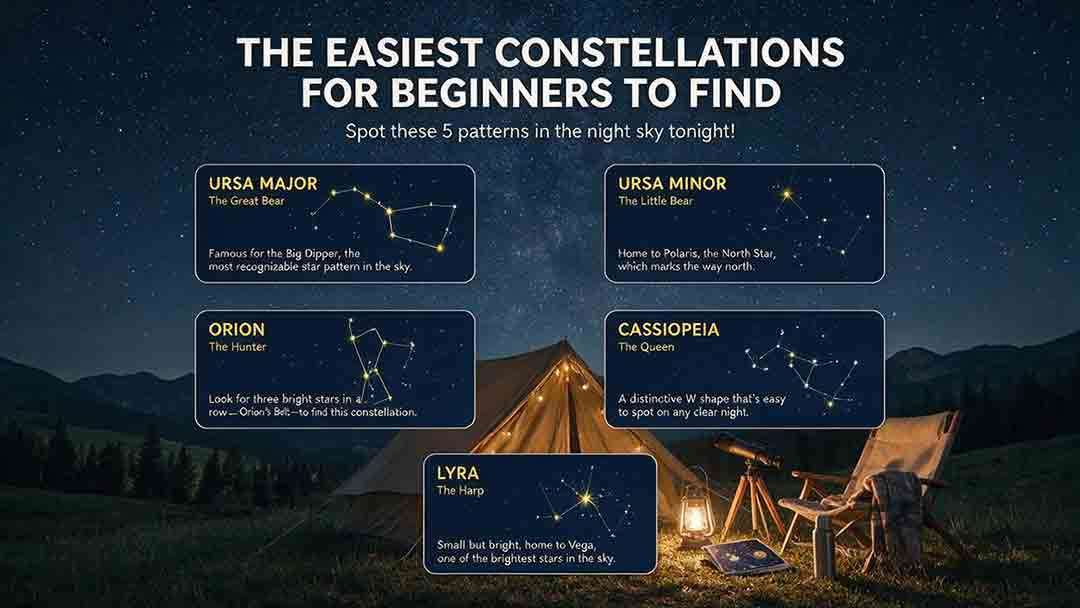
The Easiest Constellations for Beginners to Find
This beginner-friendly guide explains how to find Orion, Ursa Major through the Big Dipper, Cassiopeia, Cygnus, and Scorpius using clear naked-eye observing steps. It compares each pattern through an original Beginner Visibility Score and shows readers how to choose a first target based on season, latitude, light pollution, moonlight, and horizon visibility. The guide also clarifies the difference between constellations and asterisms, explains how the Big Dipper can point toward Polaris, and provides dedicated recommendations for Southern Hemisphere observers, including Crux. Practical tools include the Anchor-Pattern Method, the Three-Check Rule, a 10-minute observing session, city-sky guidance, troubleshooting advice, an equipment comparison, and a safety checklist. Authoritative references from the International Astronomical Union, NASA, NSF NOIRLab, and the European Southern Observatory support the key astronomical facts.
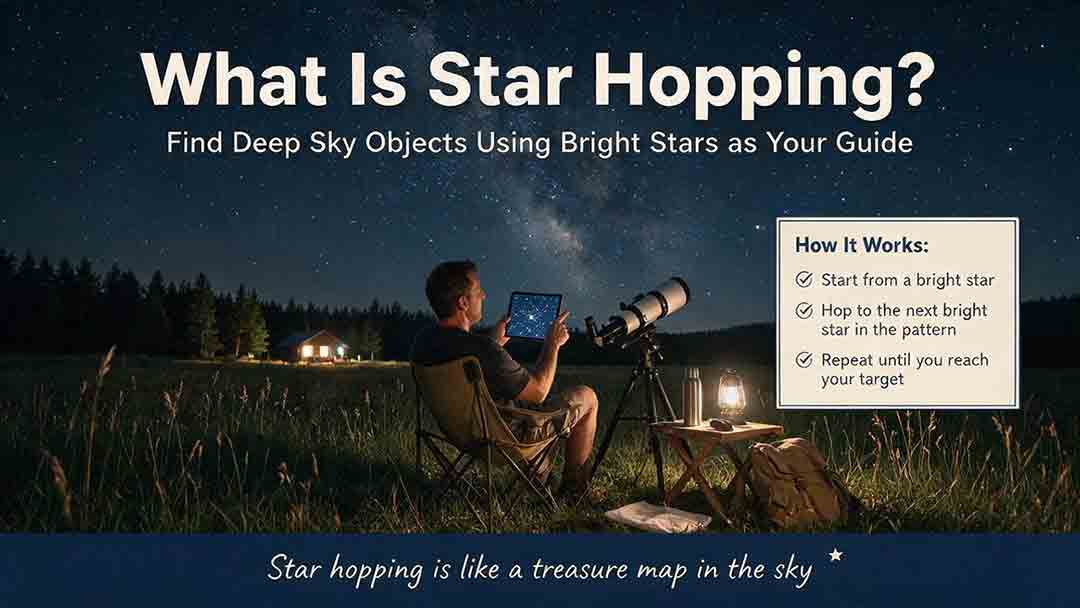
What Is Star Hopping and How Do You Do It?
Star hopping is a practical way to navigate the night sky by moving from a bright, recognizable star to a fainter target through a sequence of visible star patterns. This guide explains how beginners can plan a reliable route, align a finder, match a star chart to a telescope’s field of view, and recognize rotated or mirror-reversed images. It introduces the Anchor–Path–Field–Confirm method, provides a step-by-step observing process, and shows how field-of-view estimates can help determine a practical chart scale. A worked example demonstrates how to locate Messier 13 using the Keystone of Hercules, while the troubleshooting table addresses common problems such as finder misalignment, excessive magnification, incorrect chart orientation, and targets that remain invisible despite correct pointing. The included field checklist gives binocular and telescope users a repeatable method for planning and completing future star hops.
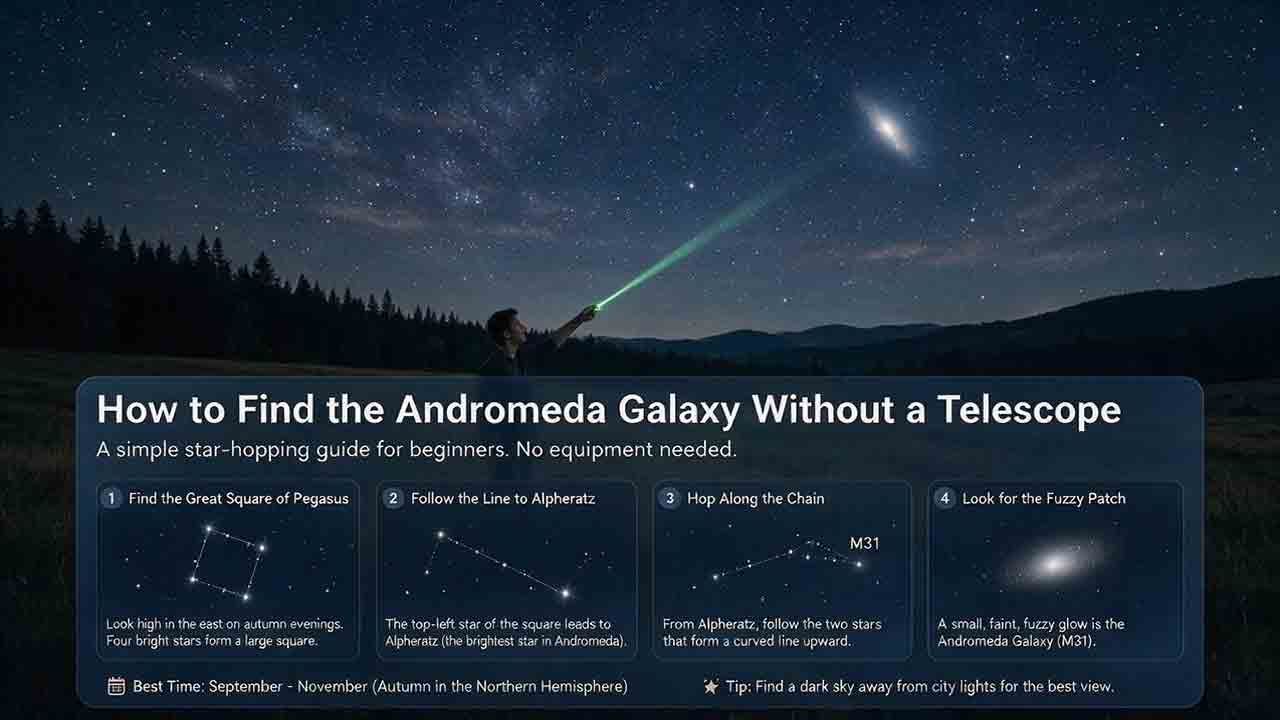
How to Find the Andromeda Galaxy Without a Telescope
Finding the Andromeda Galaxy without a telescope is possible when you know which stars to use as landmarks. This practical guide explains how to start at the Great Square of Pegasus, identify Alpheratz, follow the Andromeda star chain to Mirach, and use two nearly equal short hops to reach Mu Andromedae and M31. It also explains what the galaxy realistically looks like to the naked eye, why dark skies and averted vision matter, and how binoculars can help confirm the target. Beginners can use the six-point observing checklist, three-night practice method, troubleshooting guidance, and reusable observation log to improve each attempt. The guide distinguishes calculated angular distances from practical field estimates and clearly explains its source-checking process without claiming personal testing. It is designed primarily for Northern Hemisphere observers while also addressing visibility limitations from Southern Hemisphere locations.